17 Men Shoulder Blade Tattoo Ideas That Actually Work
Choosing a back tattoo sounds simple until you realize how many decisions sit underneath it: style, size, symmetry, visibility, and whether the design will still feel right years later. The best men shoulder blade tattoo ideas aren’t simply impressive drawings; they work because the design follows the anatomy. A great design in the wrong placement, or the wrong style for your commitment level, is how tattoo regret happens.
This guide gives you 17 tattoo directions with visual style, placement logic, aging considerations, and a practical decision point for each. These are real design directions with honest placement and artist guidance — not mood board images without context. If you’ve been saving shoulder blade tattoos without knowing which one actually fits your back, start here.
Different tattoo designs can tell different parts of your story, so browse these Inner Forearm Tattoo Ideas for Men when planning your next piece.
Men Shoulder Blade Tattoo Ideas
1. Fine-Line Botanical Branch Following the Shoulder Blade
A fine-line branch curves naturally along the scapula, using thin black stems, small leaves, and restrained negative space. The composition follows the bone rather than sitting like a sticker. fine line shoulder blade tattoo has a minimal, refined aesthetic that feels deliberate without demanding the entire back.
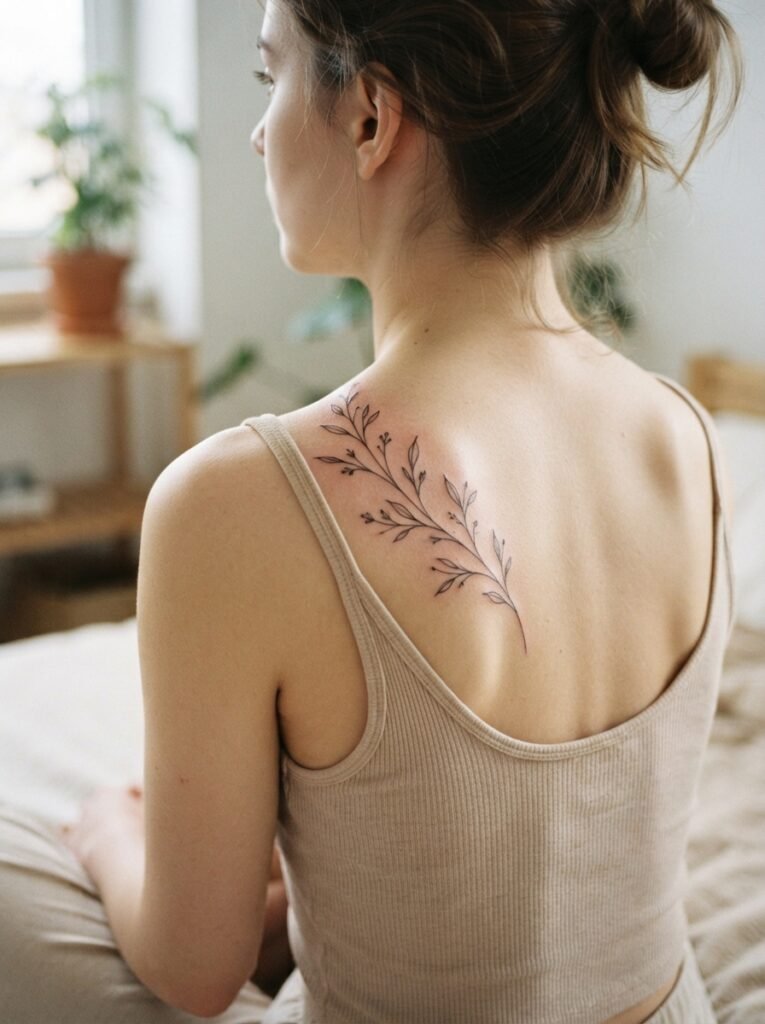
Place it horizontally or on a slight diagonal so the design moves with the shoulder. Pain is usually moderate, although the blade itself can feel sharper than surrounding muscle. It suits first-timers who want something discreet. Keep the leaves slightly open; over 10–15 years, spacing gives fine lines room to age cleanly.
2. Blackwork Raven Spreading Across the Upper Back
A raven rendered in dense blackwork uses a compact body, angular feather shapes, and selective skin breaks around the wings. The darker fill creates immediate contrast against the upper back. This blackwork shoulder blade tattoo solves the problem of wanting a masculine statement without committing to a full-back piece.
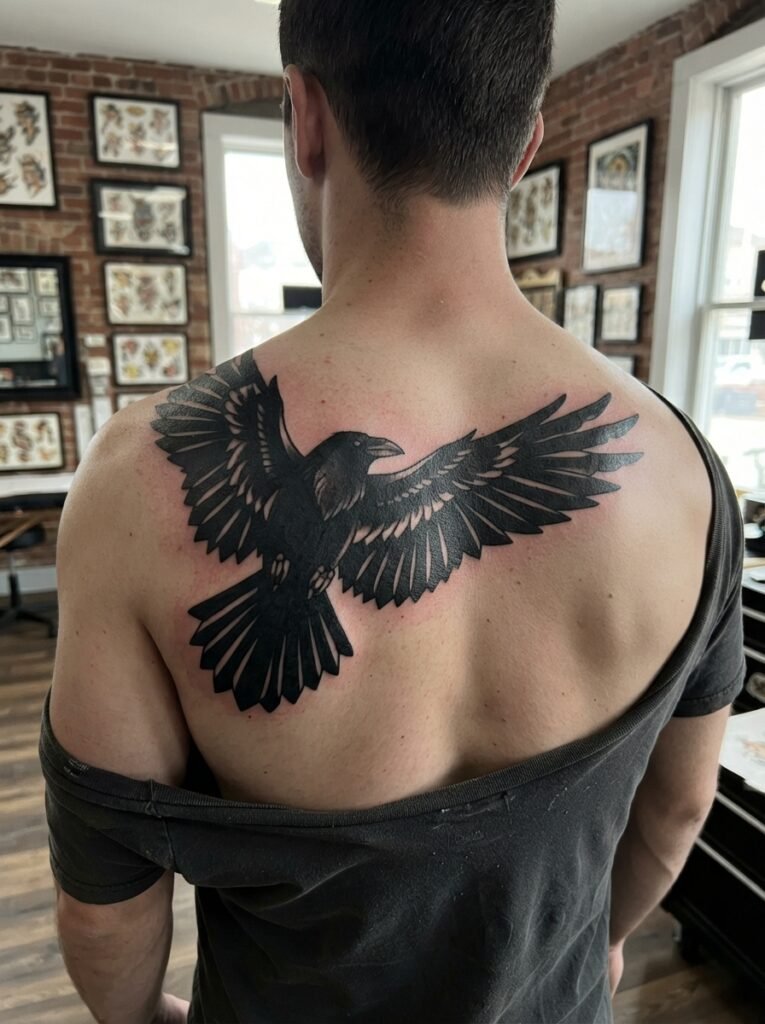
The best placement is centered over one shoulder blade with the wings extending toward the spine and shoulder. Expect moderate pain, particularly over the bone. It suits experienced collectors and men who prefer darker tattoos. Keep the black areas substantial rather than overly intricate so the silhouette remains strong as the tattoo ages.
3. Geometric Wolf Built Around the Scapula
A geometric wolf uses crisp triangular planes, symmetrical facial structure, and carefully controlled negative space. Instead of copying a realistic wolf, the design reduces the animal into architectural shapes that sit naturally over the shoulder blade. The result is graphic rather than photographic, with a precise aesthetic.
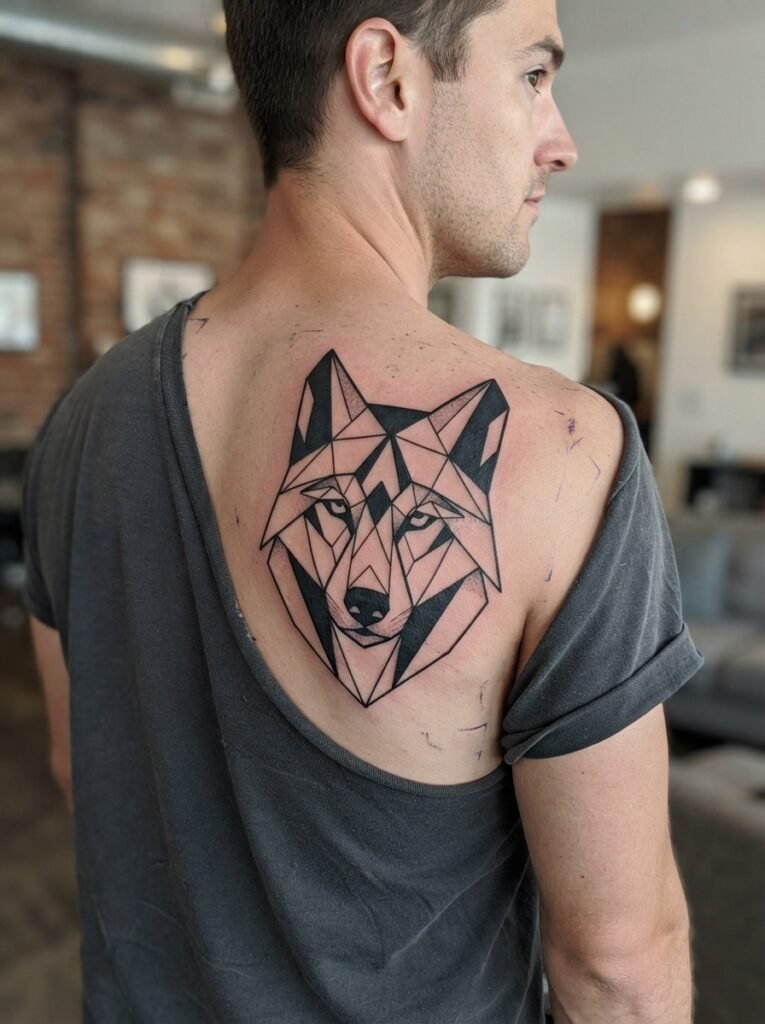
Position the wolf with its face pointing toward the spine or shoulder depending on the desired flow. Pain is moderate, and large geometric lines need accurate placement because uneven anatomy can expose mistakes. This suits men who like structured design and clean visual systems. Leave enough breathing room between shapes; that negative space is what keeps the geometry readable later.
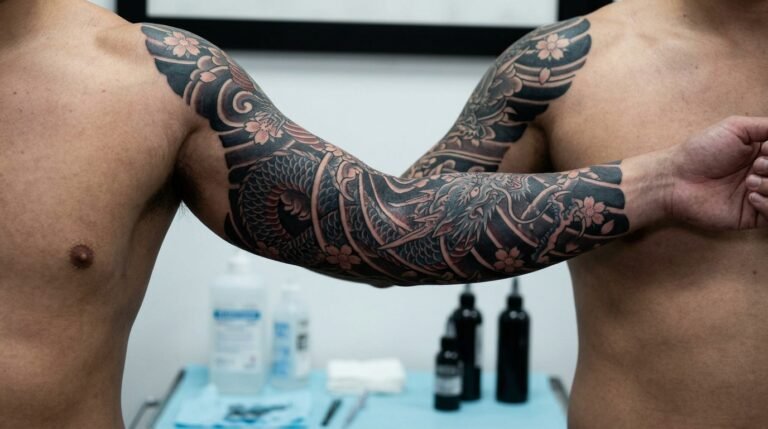
4. Illustrative Japanese Koi Sweeping Over the Blade
An illustrative koi can wrap across the shoulder blade with flowing fins, layered scales, and directional movement that follows the back muscle. Deep shading under the belly contrasts with cleaner highlights across the scales. The design feels ornate and dynamic rather than static, giving Japanese-inspired work its unmistakable visual rhythm.
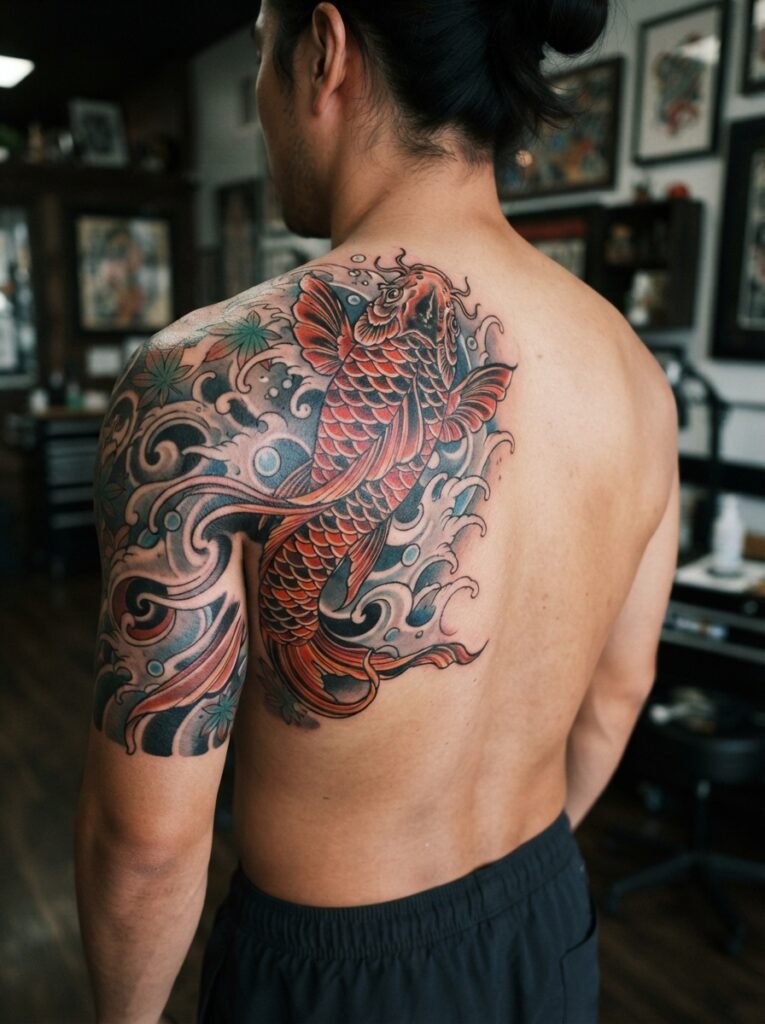
The upper back provides enough surface area for the koi to breathe without forcing details together. Pain is moderate, with longer sessions becoming more tiring than painful. It suits collectors who may eventually build a larger Japanese back or shoulder piece. Strong outlines and controlled color saturation help the image remain recognizable after years of wear.
5. Traditional Dagger and Rose Between the Shoulder Blades
A traditional dagger piercing a compact rose creates a bold vertical composition with thick outlines, solid black accents, and limited classic color. The rose softens the weapon while the dagger provides a strong central axis. This traditional shoulder blade tattoo is ideal when you want old-school impact without excessive detail.
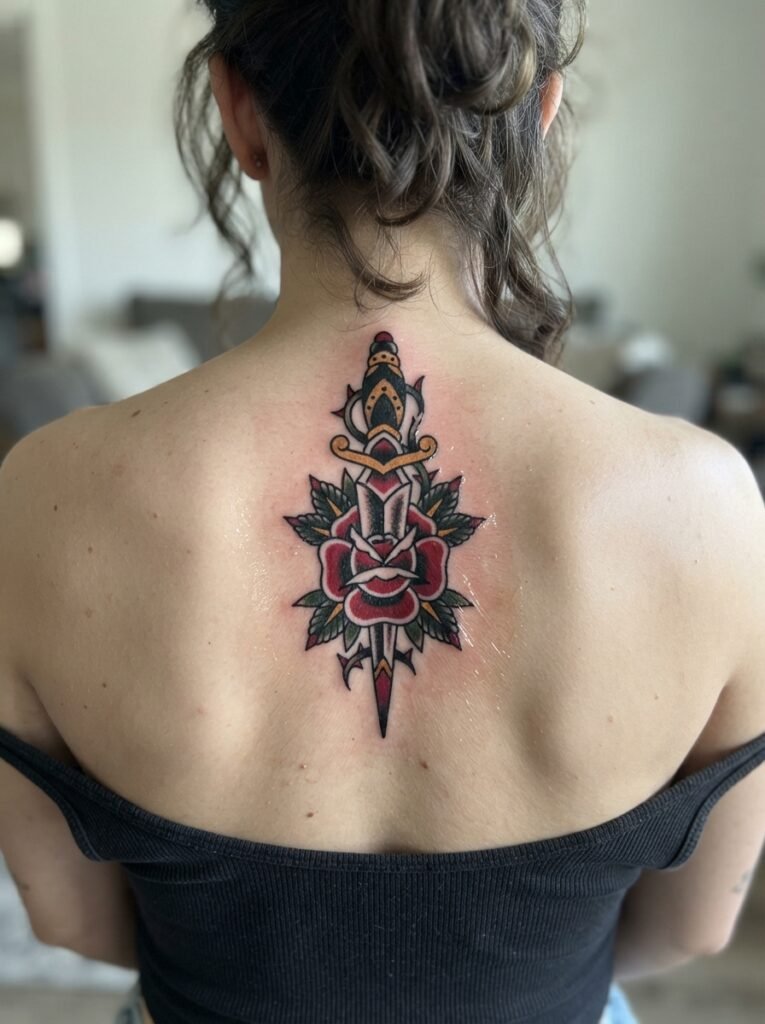
Place it between the shoulder blades or slightly toward one side if you want an asymmetrical composition. Pain is moderate and generally manageable. It works well for first-timers because traditional designs depend on readable shapes rather than microscopic detail. Heavy outlines and simple color fields make this one of the safer choices for long-term clarity.
A well-designed tattoo can become even more striking when paired with the right outfit, so explore these Look Athleisure Men for a complete look.
6. Neo-Traditional Lion With Ornamental Framing
A neo-traditional lion combines a highly expressive face with exaggerated mane shapes, thick contour lines, dimensional shading, and ornamental leaves around the head. The eyes become the focal point while the mane expands toward the natural edges of the shoulder blade. The aesthetic is dramatic, polished, and slightly theatrical.
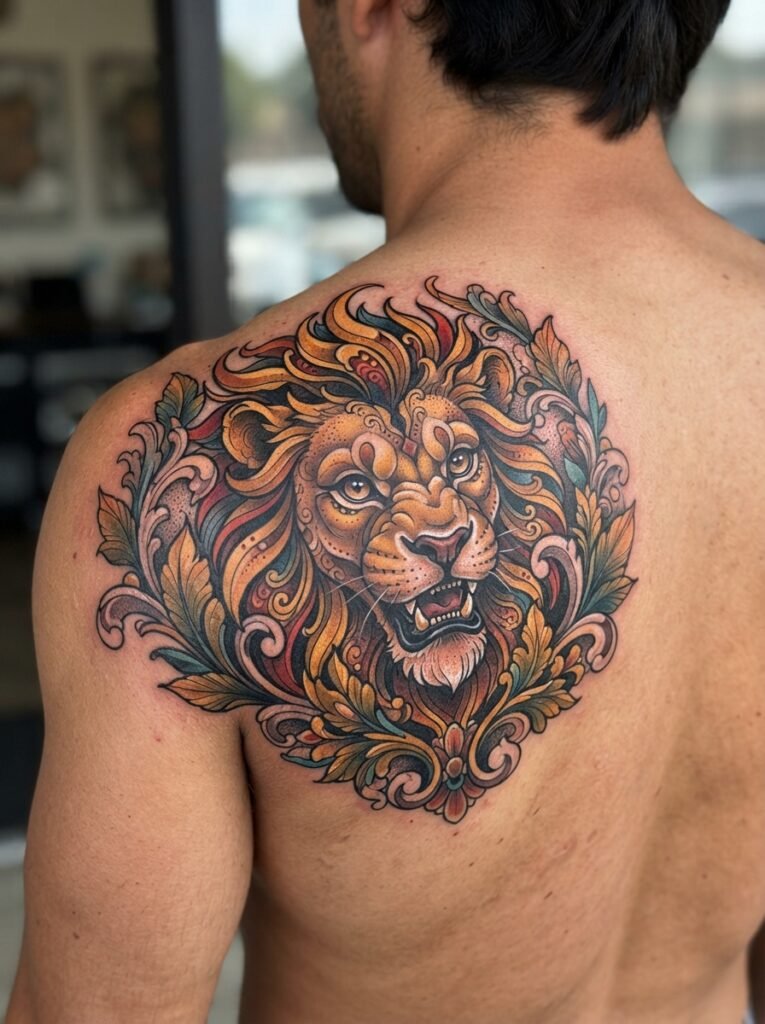
The upper shoulder blade is ideal because the lion can be centered while the mane follows the surrounding muscle. Pain is moderate, with dense shading adding time to the session. It suits collectors who want a statement piece with personality. Keep the facial features large enough to survive aging; tiny eyes and whiskers are unnecessary details.
7. Dotwork Compass With Fine Constellation Details
A dotwork compass uses graduated stippling instead of heavy shading, with a central directional point surrounded by small stars and constellation marks. The compass creates a crisp focal point while the dotwork fades softly into the skin. The result is symbolic without becoming visually heavy.
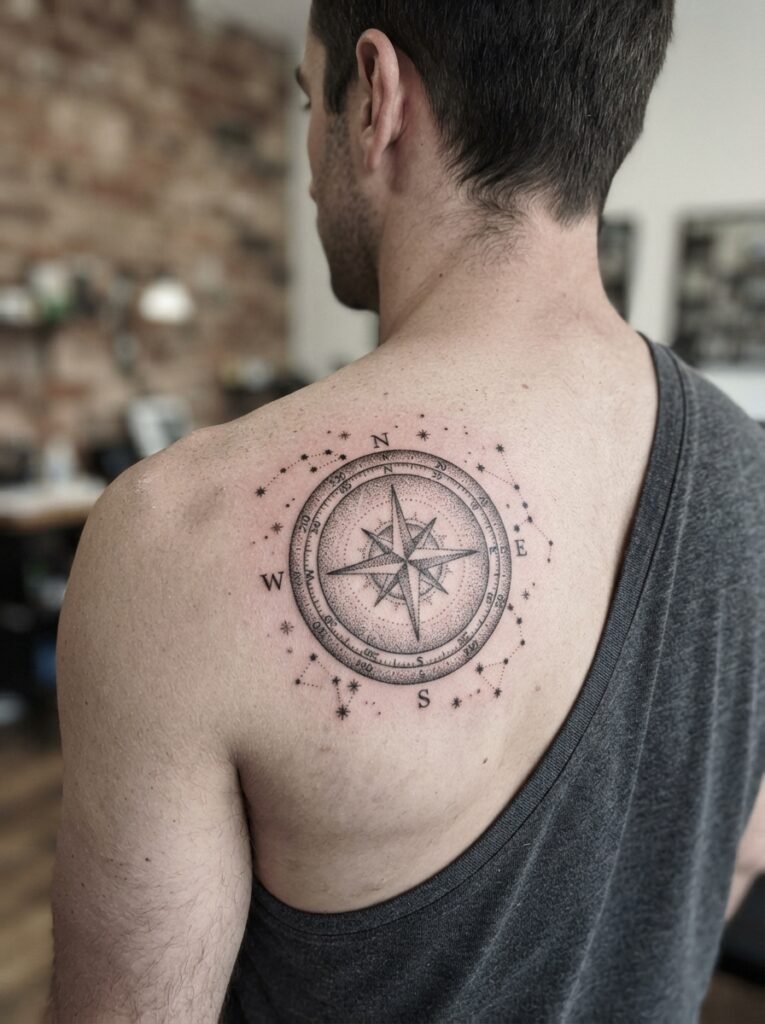
This design works particularly well on the upper shoulder blade, where the circular structure can sit against relatively broad skin. Pain is moderate, though prolonged dotwork can become tiring. It suits men who want meaning without an oversized graphic. Keep the smallest dots separated enough to prevent muddying as the tattoo matures.
8. Abstract Black Ink Lines Following the Scapula
This abstract design uses sweeping black strokes, broken curves, and negative-space interruptions to trace the natural shape of the shoulder blade. There is no single literal subject; the anatomy becomes part of the artwork. Its raw, contemporary aesthetic makes it different from conventional animal, script, or symbolic tattoos.
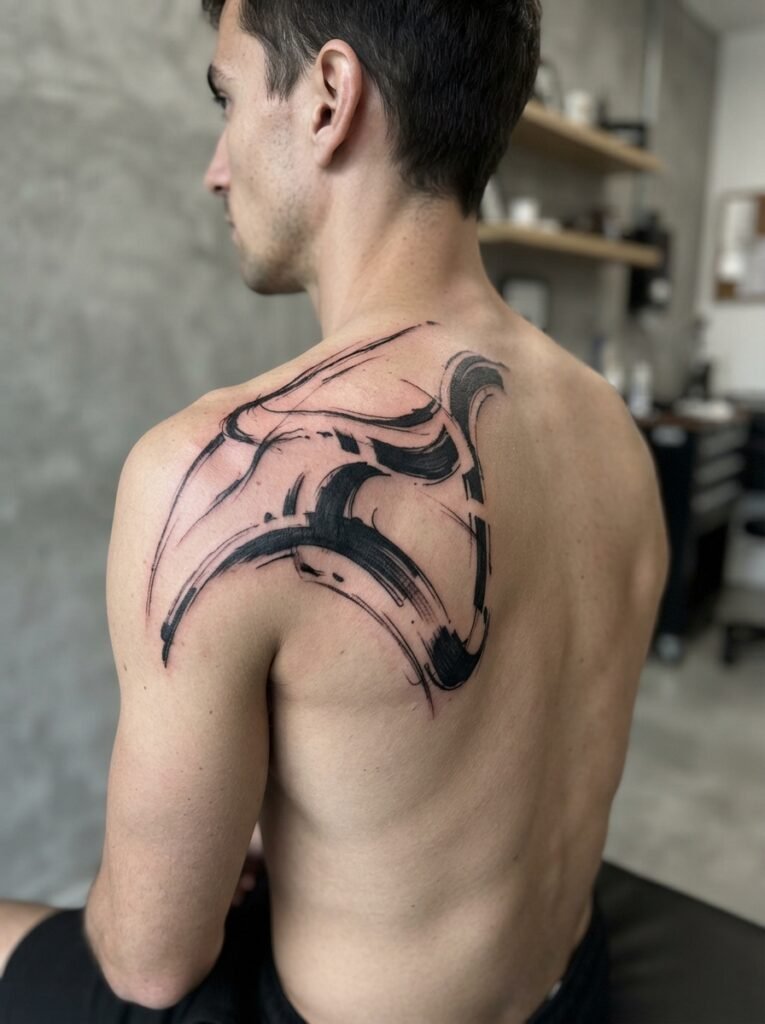
Ask your artist to draw directly on the body before finalizing the stencil. Pain is moderate, but placement accuracy matters more than complexity. It suits men with an architectural or fashion-forward taste. Because the design relies on larger shapes and open skin, it can age surprisingly well over 10–15 years.
9. Realistic Black-and-Grey Wolf Head on the Scapula
A realistic wolf uses layered black-and-grey shading to create individual fur direction, a focused eye, and gradual tonal transitions around the muzzle. The head should be large enough for the fur texture to breathe. Unlike graphic wolf tattoos, this one depends on tonal depth and photographic realism.
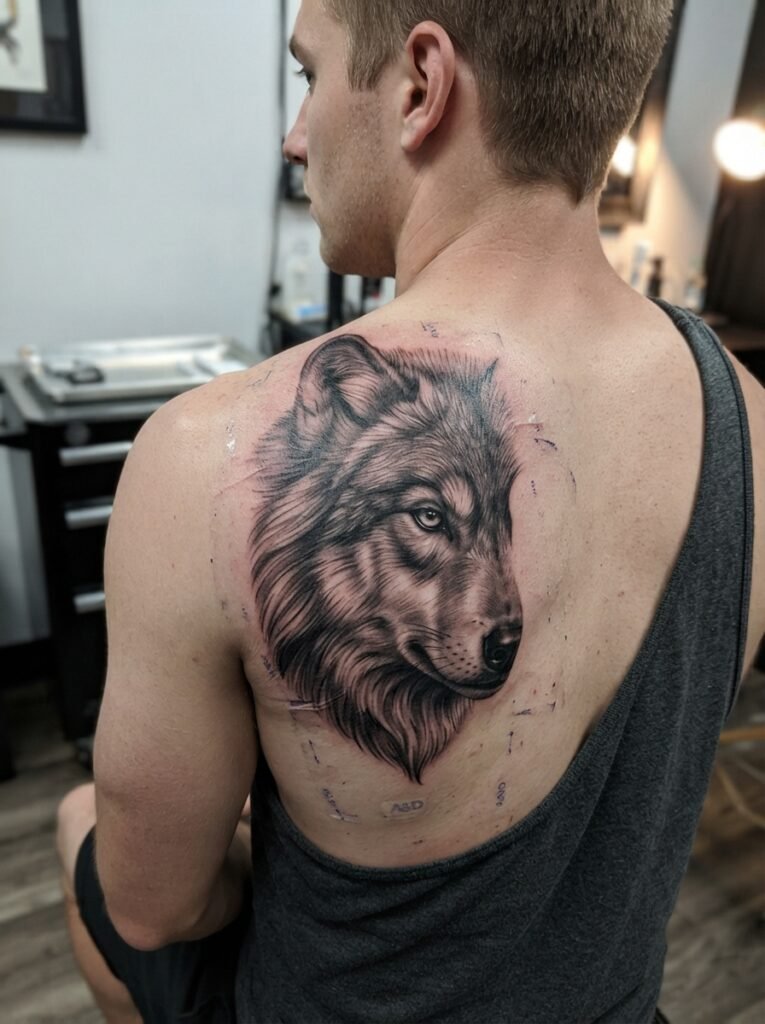
The shoulder blade gives a strong flat-ish canvas while allowing the artist to angle the head toward the spine. Pain is moderate to high during long shading sessions. Choose an artist with proven healed realism work rather than simply impressive fresh photos. Large tonal separation is essential because subtle grey values can soften considerably with age.
10. Cross With Soft Rays and Negative Space
A simple cross can be transformed into a strong shoulder blade piece through proportional sizing, soft black shading, and thin rays that extend into the surrounding skin. The design remains recognizable without looking generic. This is especially effective for men seeking a Christian shoulder blade tattoo with personal significance rather than excessive ornament.
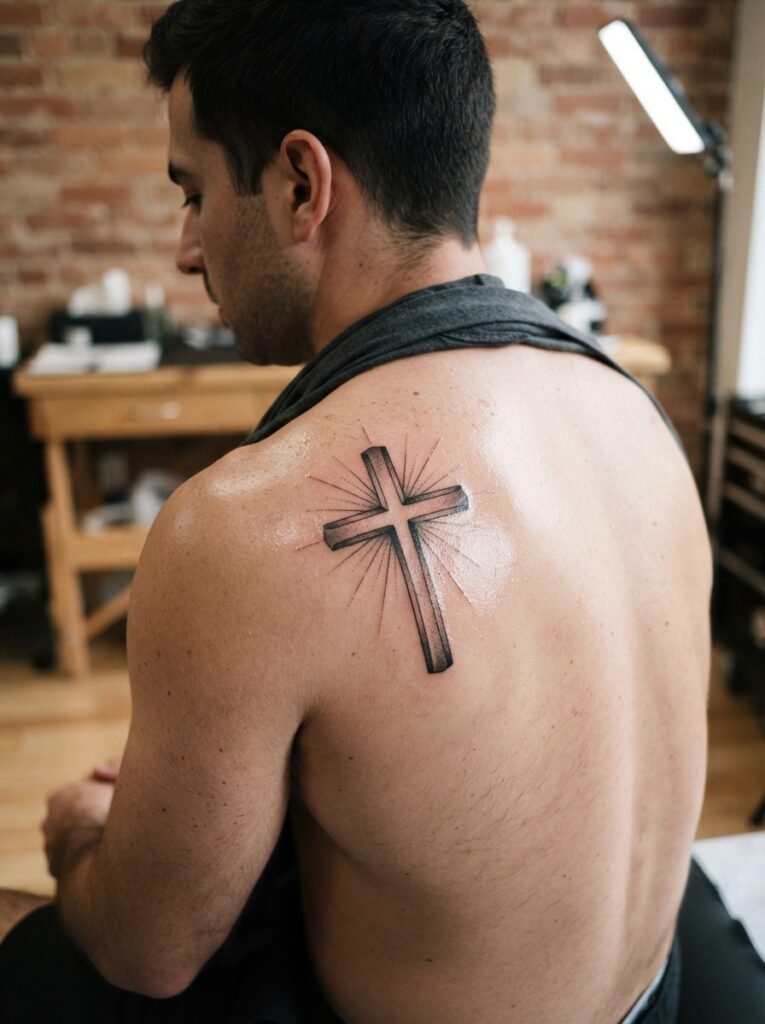
Place the cross vertically along the shoulder blade or center it closer to the spine. Pain is moderate and manageable for most people. It suits first-timers and collectors alike. Keep the rays separated from the cross so they don’t merge over time, and let negative space do some of the visual work.
The right haircut can enhance the overall impact of your ink, while these Men French Crop Haircut Ideas offer fresh ways to complete your personal style.
11. Angel Wings Curving Across Both Shoulder Blades
Large angel wings use layered feather groups that expand from the spine across both shoulder blades. The central feather structure stays compact while the outer feathers become longer and more directional. The composition is symmetrical, substantial, and unmistakably designed for the back rather than adapted from an arm tattoo.
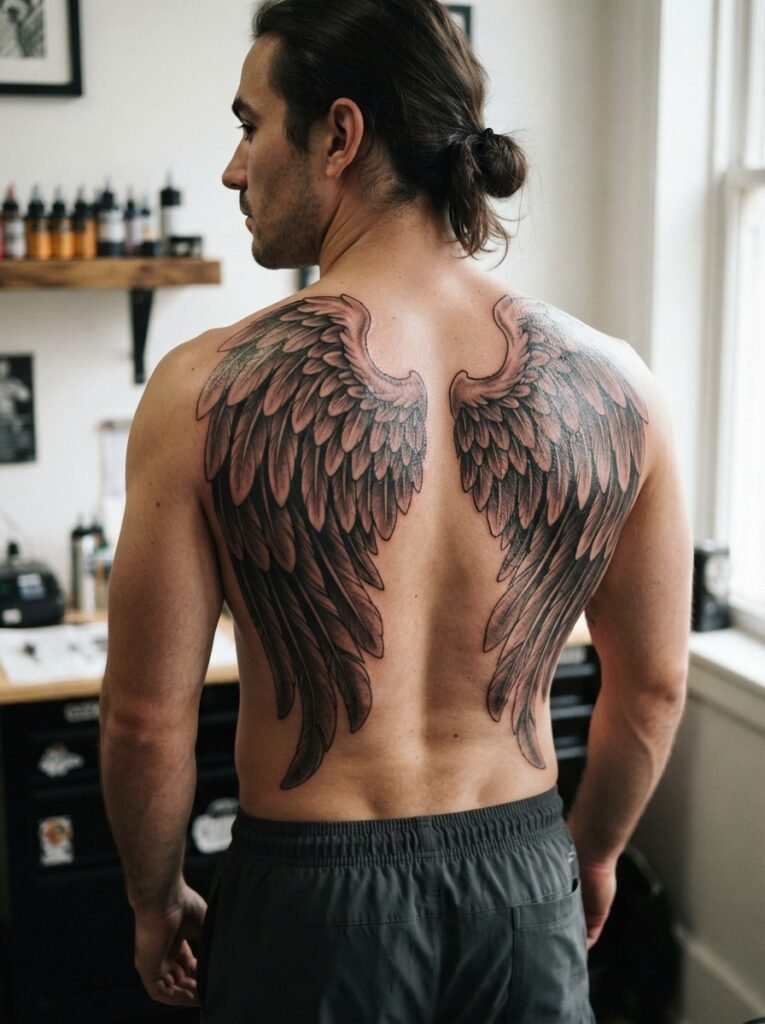
This is a large commitment, so the upper back is the obvious placement. Pain is moderate, with sessions becoming lengthy because of the surface area. It suits experienced collectors or men comfortable with a major statement. Avoid overly tiny feather details; broad feather groupings age more gracefully and keep the wings readable.
12. Minimal Script Name Along One Shoulder Blade
A name or short phrase can follow the natural horizontal curve of the shoulder blade using controlled script lettering and generous spacing. The strongest versions avoid excessive flourishes and let the lettering remain the focal point. This shoulder blade script tattoo feels personal rather than decorative.
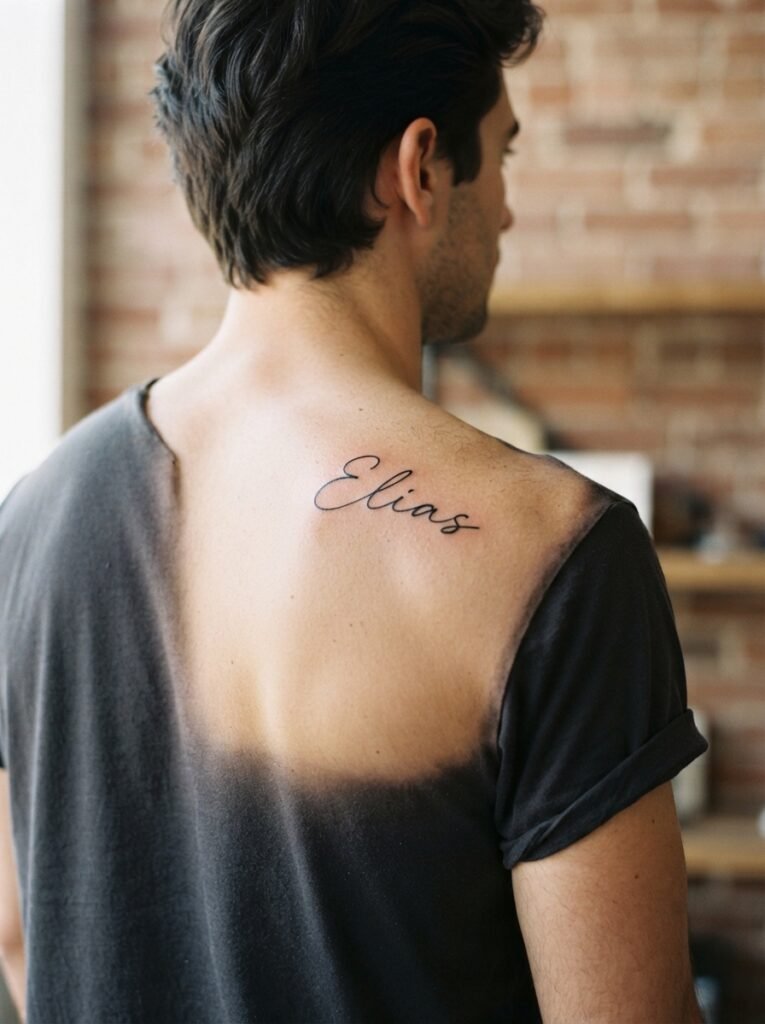
Keep the lettering large enough to preserve individual characters and avoid placing it directly over highly mobile skin. Pain is moderate. It suits men choosing a memorial, family name, or meaningful date. Ask for several handwritten lettering options rather than downloading a generic font. Clear spacing is the main factor that helps script remain legible as it ages.
13. Butterfly With Blackwork Symmetry
A butterfly centered over the shoulder blade can use bold black wings, narrow negative-space veins, and subtle geometric symmetry. For a masculine interpretation, keep the silhouette angular and graphic rather than overly delicate. The contrast between dense wings and clean skin creates a striking, modern aesthetic.
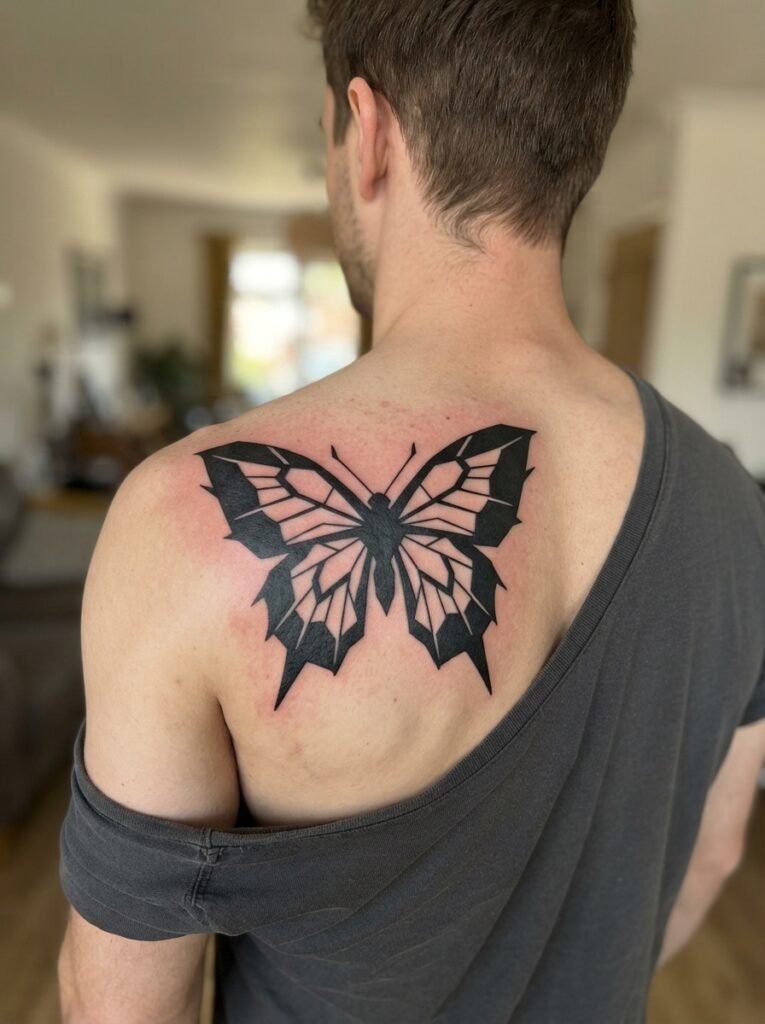
The shoulder blade gives the butterfly enough room to maintain symmetry without forcing the wings too small. Pain is moderate. It works for men who want symbolic transformation without a conventional animal tattoo. Avoid filling every wing section solid black; strategic negative space will preserve definition for much longer.
14. Anime-Inspired Character Portrait in Black and Grey
An anime-inspired portrait uses sharp facial contours, expressive eyes, controlled black shadows, and selective linework to translate a character into tattoo form. The strongest version captures the character’s recognizable expression without copying every tiny detail. The aesthetic is graphic, expressive, and highly personal.
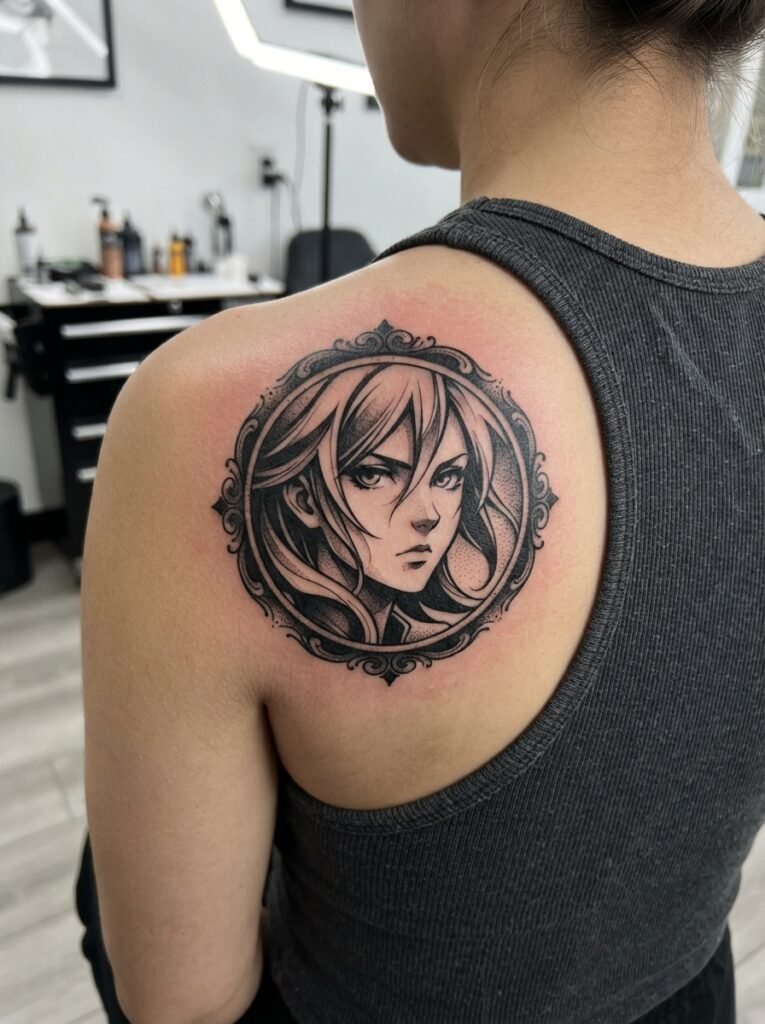
Use the shoulder blade as a framed portrait canvas, preferably with enough surrounding space to prevent the face from competing with other tattoos. Pain is moderate to high depending on shading. This suits collectors who already know the character matters to them long-term. Choose an artist experienced in anime tattooing because facial proportions are unforgiving.
15. Mountain Range With Pine Silhouette
A mountain landscape stretches horizontally across the shoulder blade using layered peaks, pine silhouettes, and controlled black-and-grey atmospheric shading. Foreground mountains remain dark while distant peaks fade into negative space. The design feels expansive despite occupying a relatively contained section of the back.
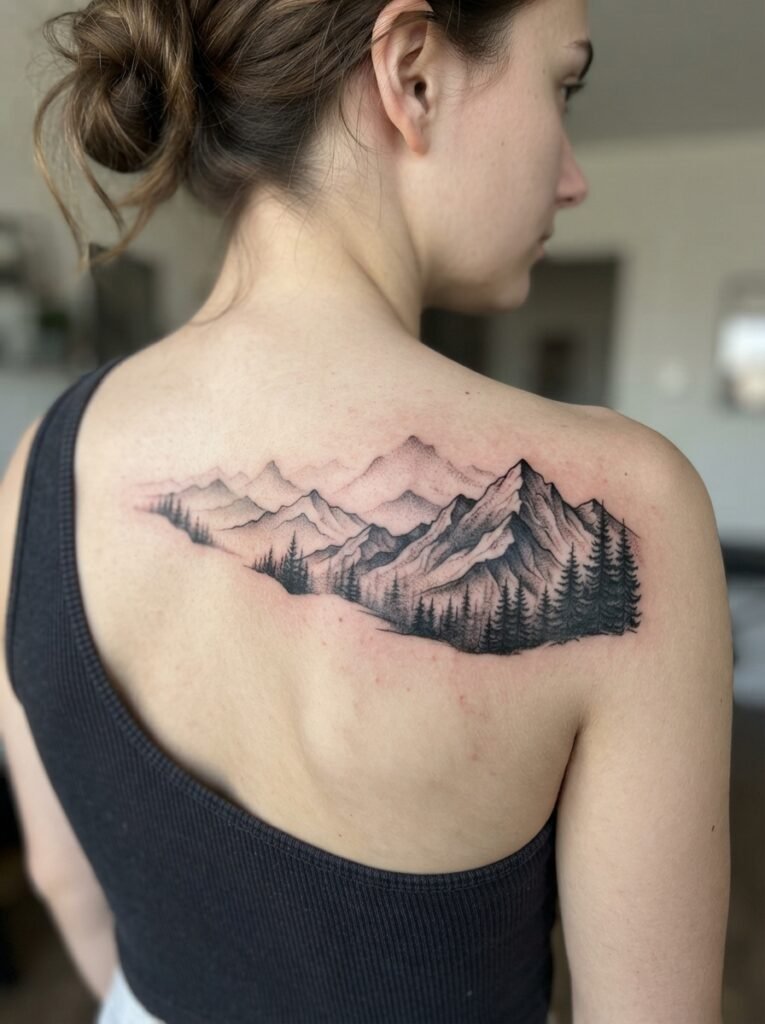
A horizontal placement works best because it follows the scapula’s broad shape. Pain is moderate and generally easier than highly saturated pieces. It suits first-timers who want a meaningful nature tattoo without obvious symbolism. Keep distant mountains simple; too many layers eventually collapse into a dark band.
A strong tattoo often pairs naturally with facial hair, and these Men Beard With Buzz Cut Ideas can add another distinctive element to your appearance.
16. Architectural Roman Statue With Fine Detail
A Roman-style statue portrait combines stone-like facial shading, cracked textures, and ornamental framing around the shoulder blade. The portrait sits vertically while the surrounding architecture expands into the upper back. This creates an ancient, sculptural aesthetic that feels far more deliberate than a standard portrait.
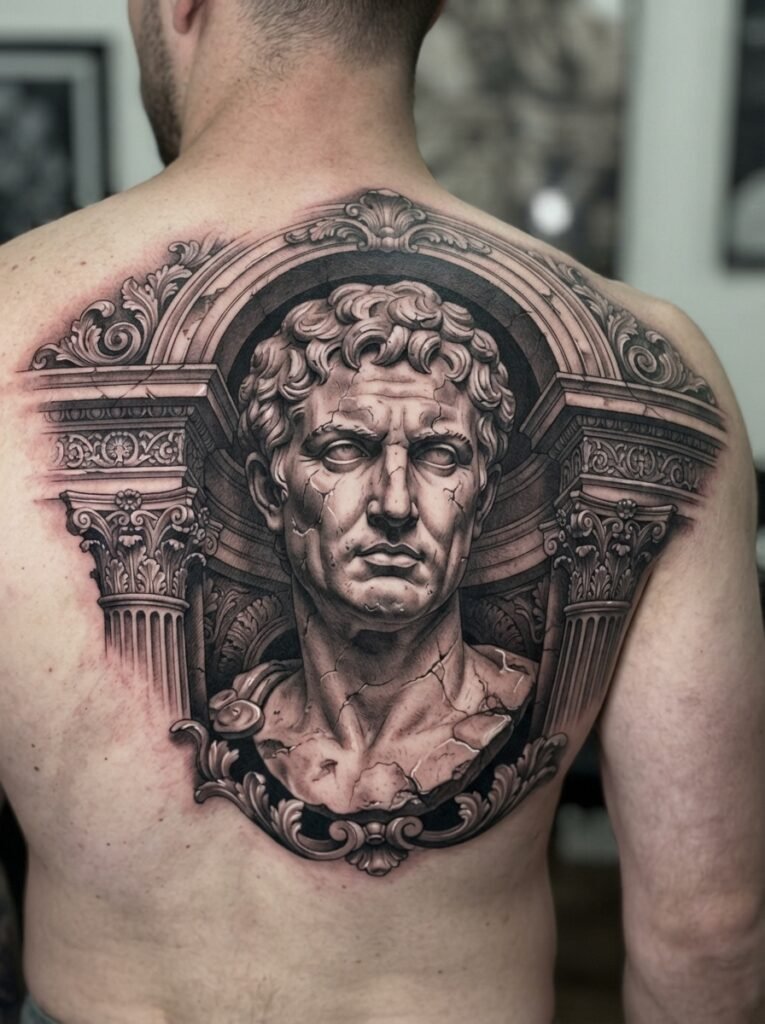
Use enough surface area to preserve facial proportions and tonal transitions. Pain can be moderate to high during a long realism session. It suits experienced collectors and men drawn to classical imagery. The key aging decision is scale: larger facial features and stronger tonal separation will survive skin changes better than miniature realism.
17. Phoenix Rising From the Shoulder Blade
A phoenix begins with a compact body near the scapula and expands upward through sweeping wings, flame-like feathers, and a rising tail. Blackwork or black-and-grey shading can make the silhouette powerful while leaving selected areas of skin untouched. The overall aesthetic is dark, symbolic, and dramatic.
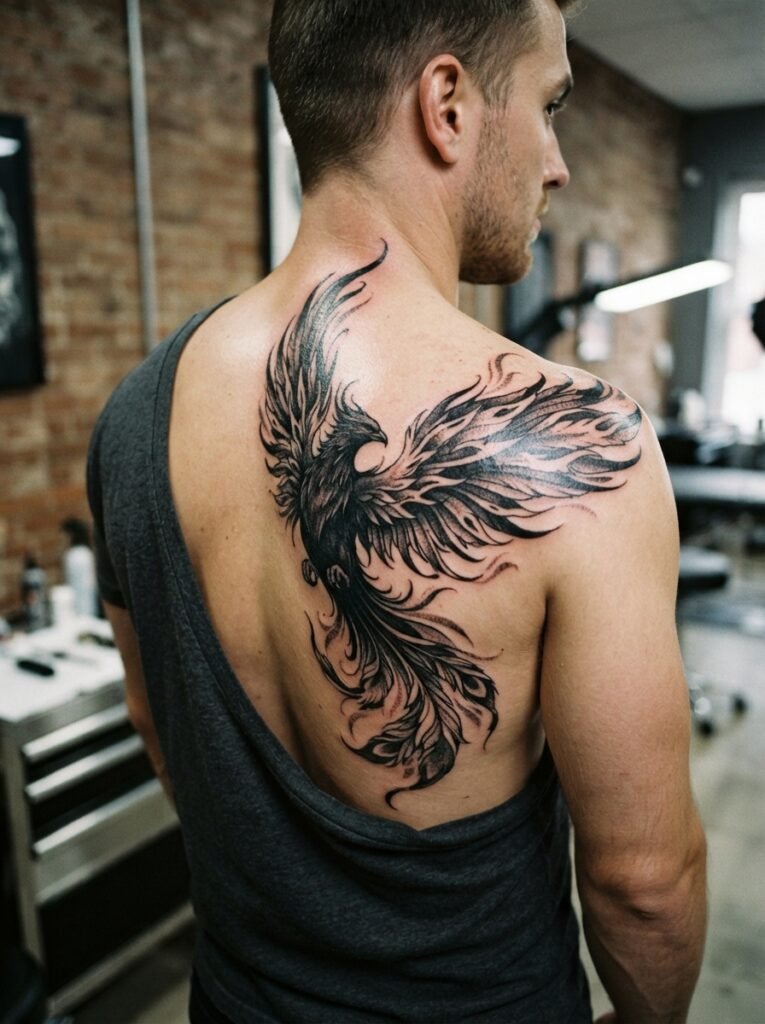
Place the body over the shoulder blade and let the wings move toward the upper back or shoulder. Pain is moderate, with dense shading increasing session time. It suits men looking for a transformation or comeback theme. Keep the wings open and directional so the phoenix remains recognizable rather than becoming one dense black shape with age.
Best Tattoo Placements
| Placement | Visibility | Pain Level | Best Design Scale | Ages Well? |
|---|---|---|---|---|
| Forearm | High | Moderate | Medium–Large | ✓ Yes |
| Chest | Low–Medium | Moderate–High | Large | ✓ Yes |
| Back | Low | Moderate | Very Large | ✓ Yes |
| Wrist | High | High | Small | ⚠️ Fades faster |
| Upper arm | Medium | Low | Medium–Large | ✓ Yes |
For men considering shoulder to elbow tattoo ideas, remember that the upper arm and shoulder blade can also become part of a larger progression. A shoulder blade design doesn’t have to stay isolated forever; an experienced artist can leave intentional negative space for future work.
What to Know Before Getting Your First Tattoo
Most tattoo regret is a research failure, not a design failure. Here’s what to know before you book.
Find an artist through healed work. Fresh tattoos can look spectacular immediately after a session. Ask to see healed work from the same artist, especially examples in the style you want.
Bring reference images. Three or four strong references communicate line weight, composition, shading, and mood much better than saying, “I want something masculine.”
Think carefully about size. Tiny realism, tightly packed script, and microscopic geometric details can shrink into visual noise. Give detailed designs enough space to breathe.
Treat the first two weeks seriously. Picking at peeling skin, soaking the tattoo, and exposing it to excessive friction are three easy ways to interfere with healing. Follow your artist’s specific aftercare instructions.
Avoid the obvious shortcuts. Stay away from unnecessary sun exposure, pools, tight clothing over a fresh tattoo, and shops chosen purely because they’re cheapest. Price should never be the deciding factor for permanent work.
A tattoo is the one purchase you can’t return. Spend more time on the artist research than the design research — the right artist will improve your idea anyway.
If you already have one meaningful design, exploring more Lower Arm Tattoo Ideas for Men can help you discover complementary concepts for building a cohesive collection.
Frequently Asked Questions
How much does a forearm tattoo cost?
Pricing varies by artist, location, size, style, and session time. A small simple piece costs far less than a detailed realism or sleeve project, so ask for a quote after showing references.
How long does a forearm tattoo take to heal?
Most tattoos go through their main surface-healing stage in roughly two weeks, while deeper skin recovery continues longer. Follow your artist’s aftercare instructions throughout the process.
What tattoo style ages the best?
Bold traditional, blackwork, and well-spaced designs generally hold their visual structure well. Fine detail can age successfully too when the tattoo is properly sized and placed.
Conclusion
The best men shoulder blade tattoo ideas aren’t defined by one trend or one style. You now know how fine line, blackwork, geometric, traditional, realism, script, Japanese-inspired, and symbolic designs behave differently on the shoulder blade — and why size, negative space, anatomy, and artist specialization matter. Your strongest choice will match your aesthetic identity, commitment level, and the artist you trust, rather than whatever tattoo happens to be trending.
Before booking, save 5–10 reference images that share a consistent style — not 10 different styles you like equally. That collection is your brief. Take it to a consultation, not a booking, first. A good tattoo is permanent, but permanence is the advantage: a good tattoo is the one decision that gets better with time, not worse.