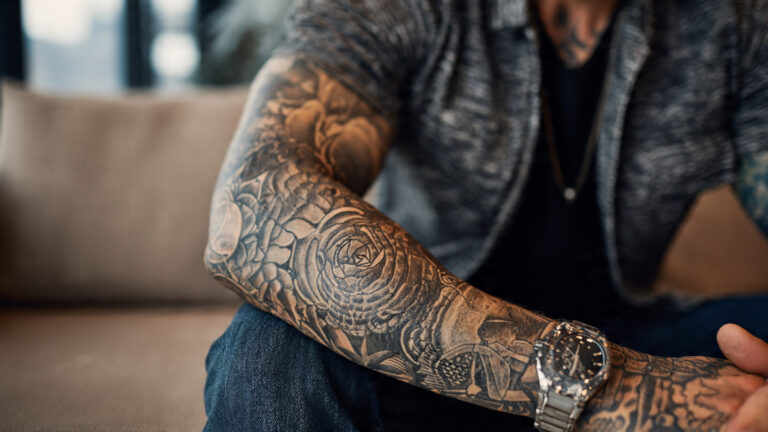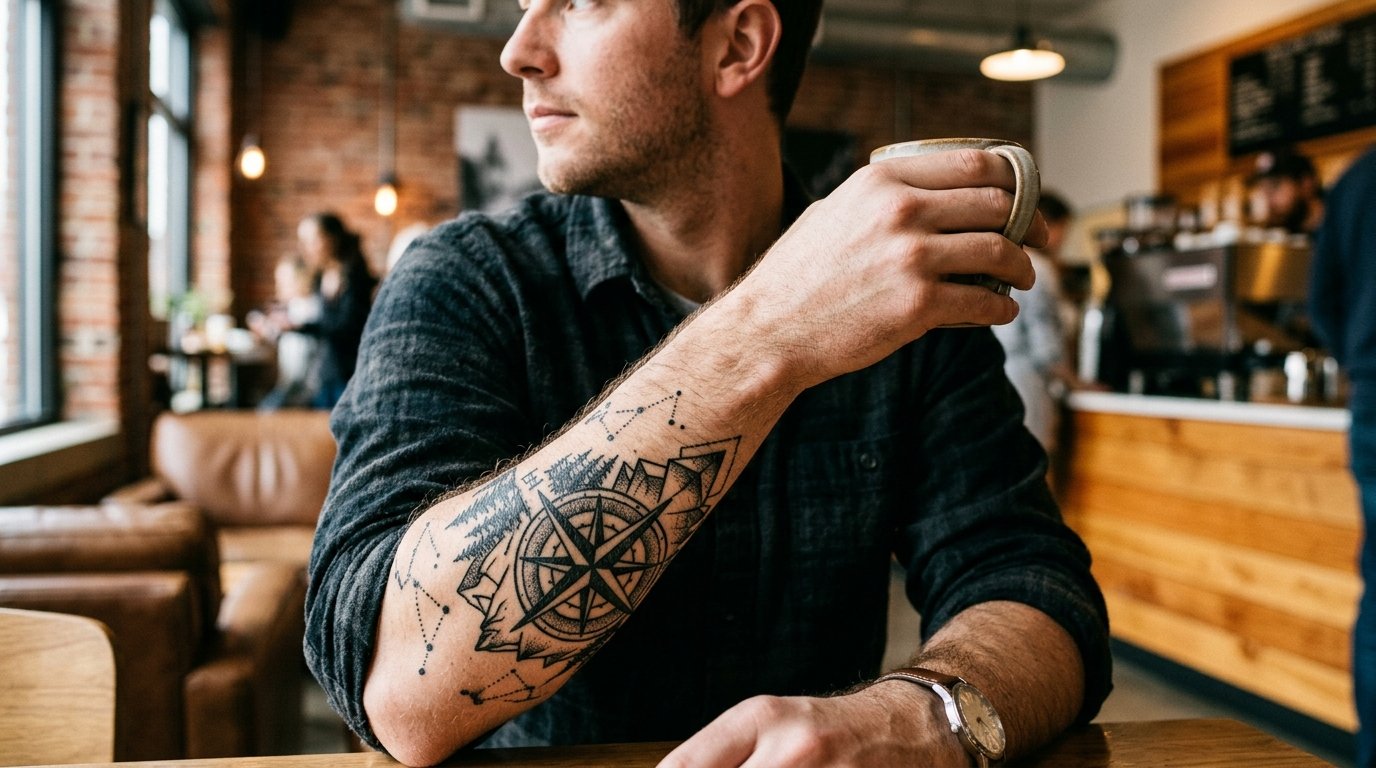
17 Men Outer Forearm Tattoo Ideas That Actually Work
Choosing between men outer forearm tattoo ideas can create a surprisingly difficult problem: there are too many styles, unclear placement rules, and the nagging fear that today’s favorite design will become tomorrow’s regret. The most important decision isn’t the design itself — it’s matching the style to the forearm’s anatomy, your visibility preference, and your commitment level. A great design in the wrong placement, or the wrong style for your commitment level, is how tattoo regret happens.
This guide gives you 17 tattoo ideas with specific style identification, placement logic, aging considerations, and a practical decision point for each. These are real design directions with honest placement and artist guidance — not mood board images without context. Whether you’re considering a simple forearm tattoo, a religious piece, or something that can eventually become a half sleeve, you’ll know what actually works before you sit in the chair.
If you already have one meaningful design, exploring more Lower Arm Tattoo Ideas for Men can help you discover complementary concepts for building a cohesive collection.
Men Outer Forearm Tattoo Ideas
1. Fine-Line Compass With Botanical Framing
A slim compass sits vertically along the outer forearm, surrounded by tiny olive branches and controlled single-needle details. The line weight stays deliberately light, with almost no solid shading, creating a refined minimal aesthetic that feels more like engraved artwork than conventional body art.
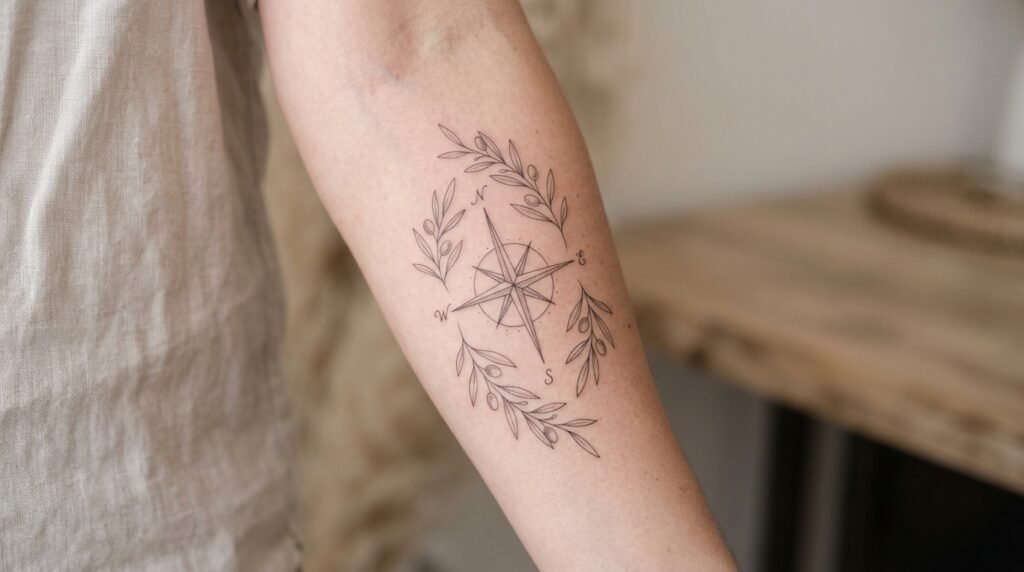
Place the compass through the central outer forearm where the elongated anatomy gives the design room to breathe. Pain is usually moderate and manageable, making this suitable for a first-timer. Keep it black or add restrained gray; over 10–15 years, slightly thicker lines and adequate spacing help preserve readability.
2. Blackwork Lion Head With Heavy Shadow
A lion’s face fills the outer forearm with dense blackwork around the mane while negative skin creates the eyes, muzzle, and directional fur. The contrast is deliberately aggressive: broad black sections sit beside clean skin breaks, giving the piece a raw graphic character instead of photographic softness.
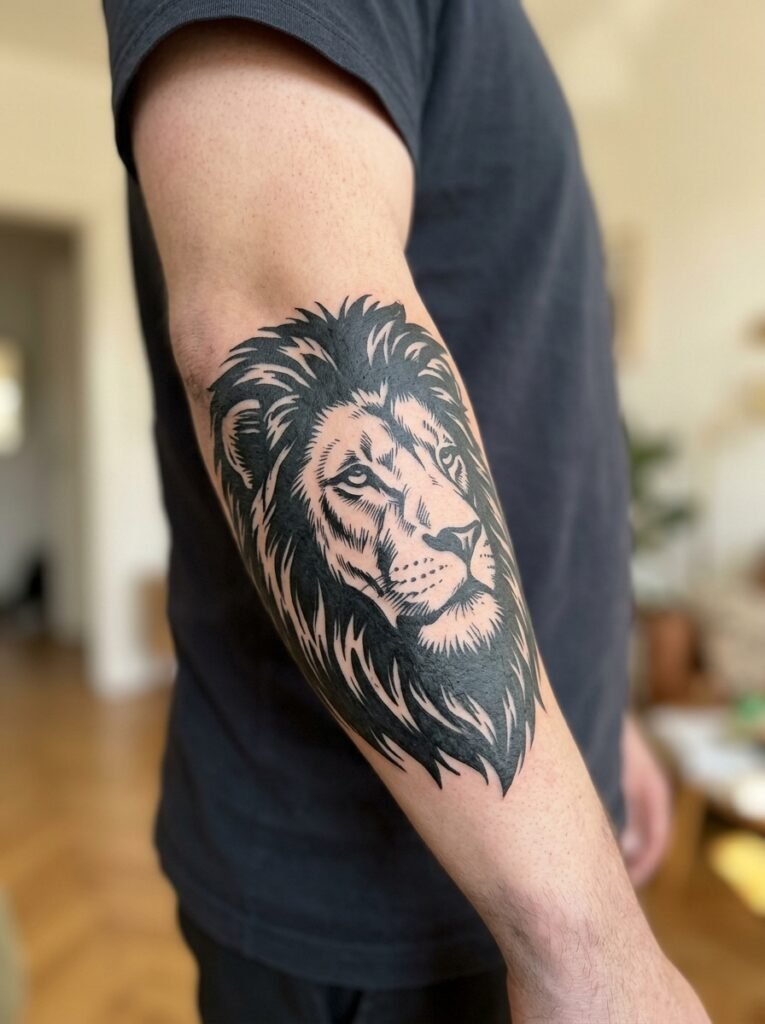
The upper outer forearm works particularly well because the wider anatomy accommodates the mane without compressing it. Expect moderate pain, especially around thinner areas. It suits collectors who want immediate visual impact, and the mane can later connect into a sleeve. Heavy blackwork generally maintains its presence well as it ages.
3. Geometric Wolf Built From Interlocking Shapes
A wolf’s profile is constructed from triangles, hexagons, and precise angular lines rather than conventional fur detail. The face remains recognizable while sections dissolve into geometric fragments, creating a graphic composition that looks different from standard wolf tattoos.
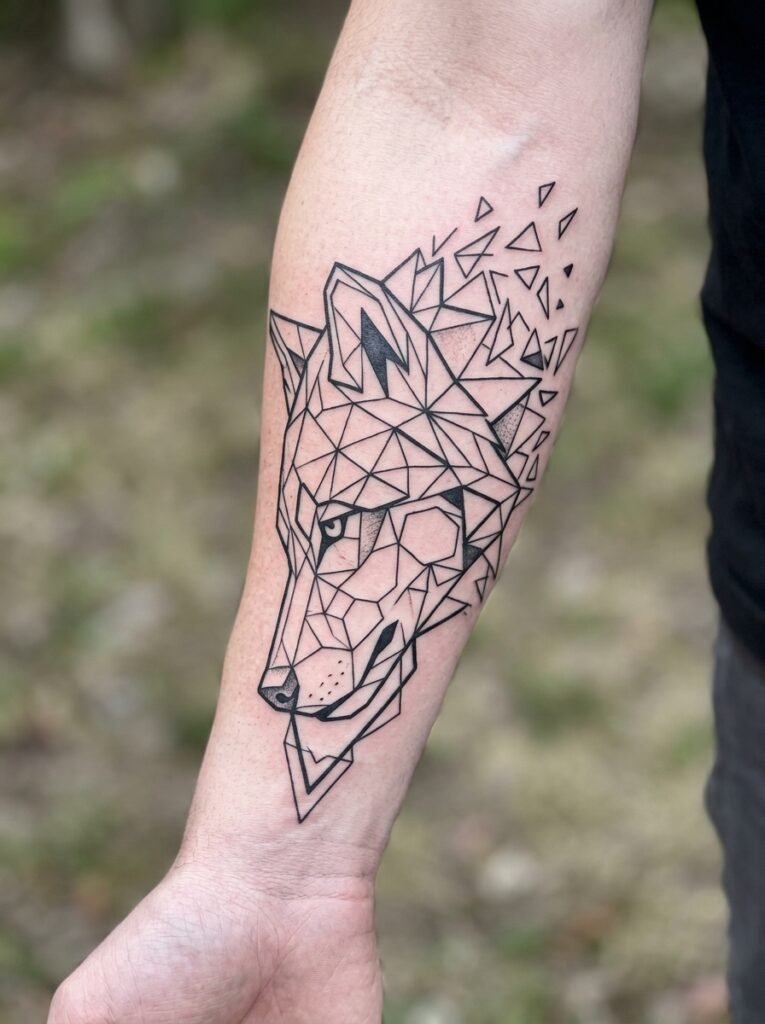
Center it on the outer forearm and run the muzzle toward the wrist for a natural vertical flow. Pain is moderate, with longer sessions depending on how much linework is included. This is a strong choice if you like order and symmetry; keep enough negative space between shapes so the geometry remains crisp after years of natural spreading.
4. Illustrative Greek God With Draped Robes
An illustrative Greek deity is rendered from the chest upward, with carved facial features, flowing robes, and controlled shadows that mimic an old marble sculpture. Fine contour lines transition into textured shading, giving the piece an ornate museum-sketch appearance rather than a flat character portrait.
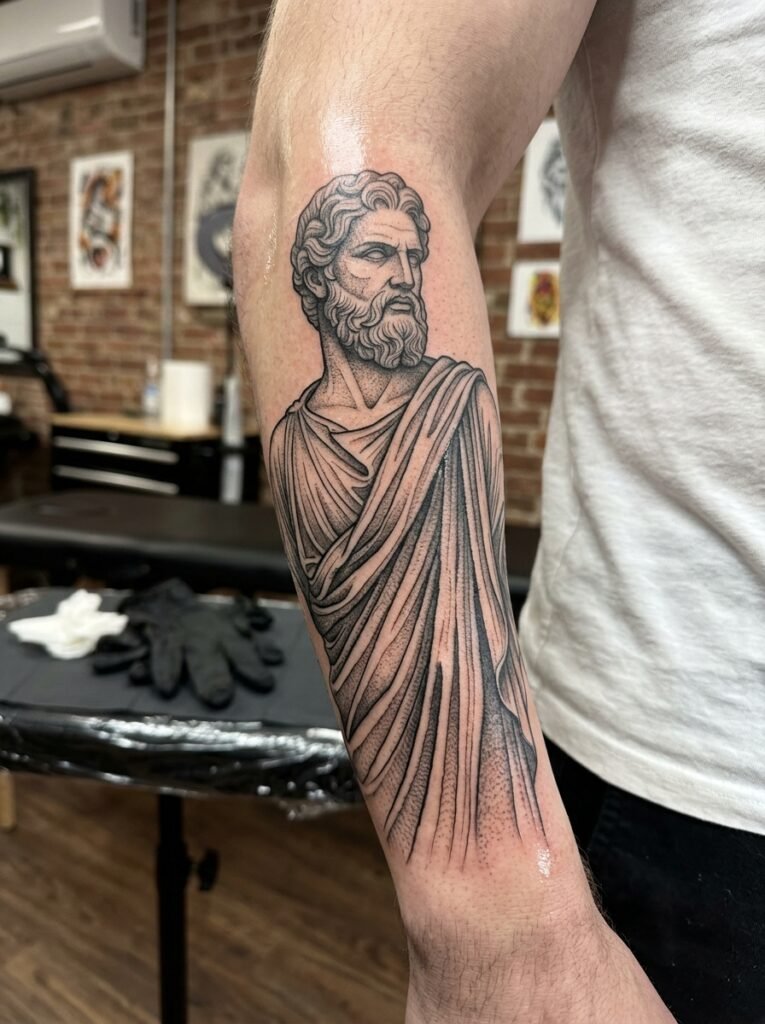
The outer forearm provides a strong vertical canvas for the face and robe folds, while the wider upper section gives the head enough breathing room. Pain is moderate to high during detailed shading. This suits experienced collectors who appreciate mythology and longer sessions. Use black and gray rather than excessive color for a design that can retain its sculptural character as it matures.
5. Traditional Eagle With Saturated Banner
A bold eagle spreads its wings across the forearm using thick black outlines, compact red accents, and a tightly curved banner beneath the talons. The heavy contour and simplified feather shapes create a symbolic old-school look that reads immediately without relying on tiny details.
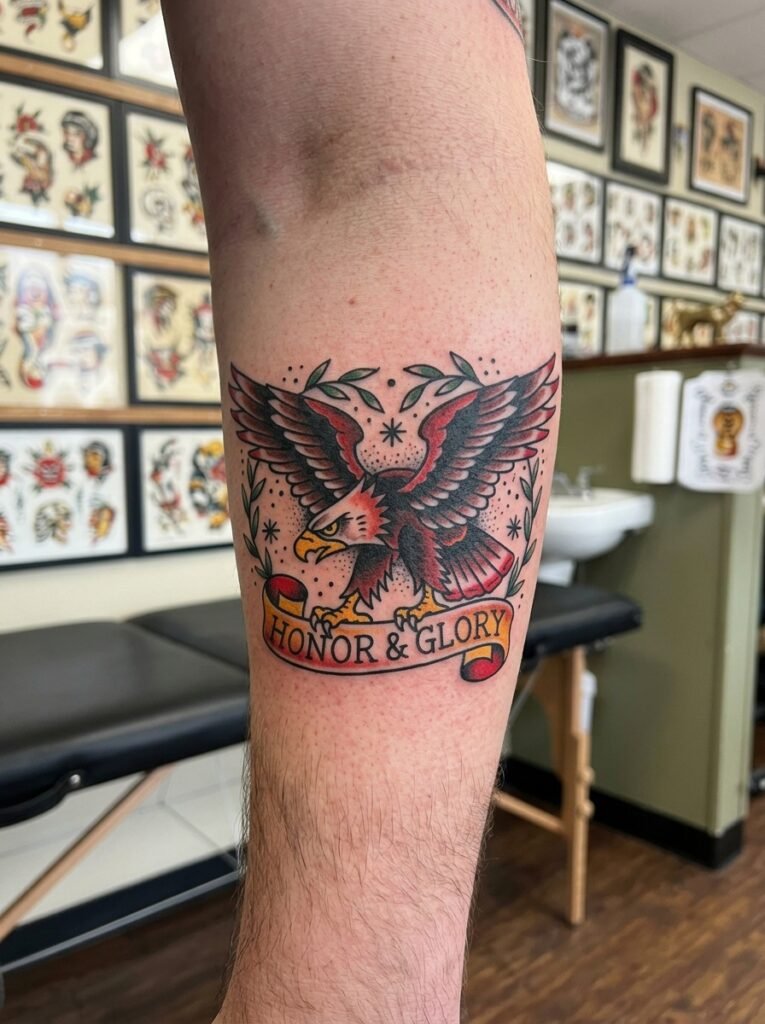
Position the eagle across the broadest portion of the outer forearm so the wings aren’t forced into a narrow column. Pain is moderate, and the style suits both first-timers and experienced collectors. Replace the banner text, alter the color palette, or extend the wings into surrounding traditional motifs. Thick outlines and solid color make this one of the safer choices for long-term readability.
A well-designed tattoo can become even more striking when paired with the right outfit, so explore these Men Dark Streetwear Aesthetic Outfit Ideas for a complete look.
6. Neo-Traditional Snake Around a Dagger
A thick-bodied snake coils diagonally around an ornate dagger, with exaggerated scales, jewel-like eyes, and controlled black shadows. The composition combines bold outlines with dimensional color and decorative details, producing a dark neo-traditional aesthetic that has more depth than classic traditional work.
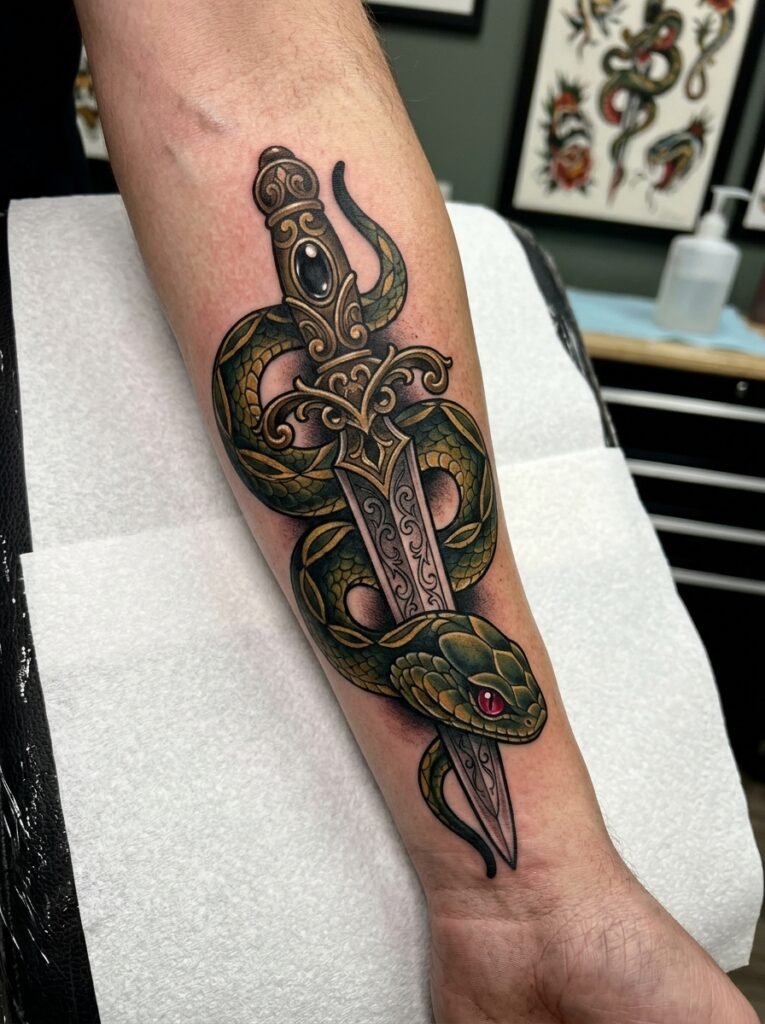
The outer forearm is ideal because the snake naturally follows the arm’s length while the dagger creates a strong central axis. Pain is moderate, although saturated color can increase session discomfort. It suits someone wanting a statement piece that can eventually become part of a sleeve. Keep the scale details reasonably open so they don’t merge with age.
7. Dotwork Sacred Geometry Mandala
Concentric circles, tiny dots, and symmetrical petals form a mandala that gradually expands from a narrow central point. The shading comes almost entirely from dot density rather than solid fills, creating a symbolic design with a softer visual transition than heavy blackwork.
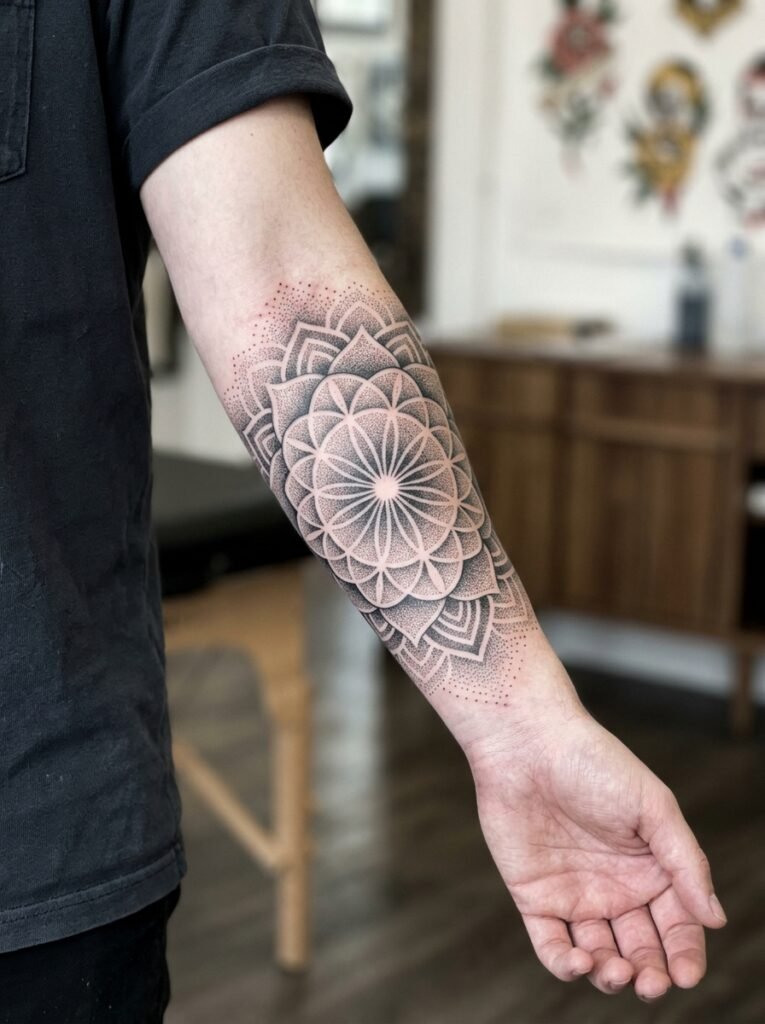
Place the central axis over the outer forearm and let the circular forms follow the arm’s natural width. Pain is moderate, particularly during prolonged stippling. It works for someone who wants detail without a realistic image and can be enlarged into a half sleeve. Avoid making the smallest dots excessively close together; breathing room is critical for long-term clarity.
8. Abstract Black Ink Flow With Negative Space
Irregular black shapes sweep vertically down the arm while curved negative-space channels interrupt the ink like cracks through stone. There is no single literal subject, which makes the composition feel raw and contemporary rather than symbolic in an obvious way.
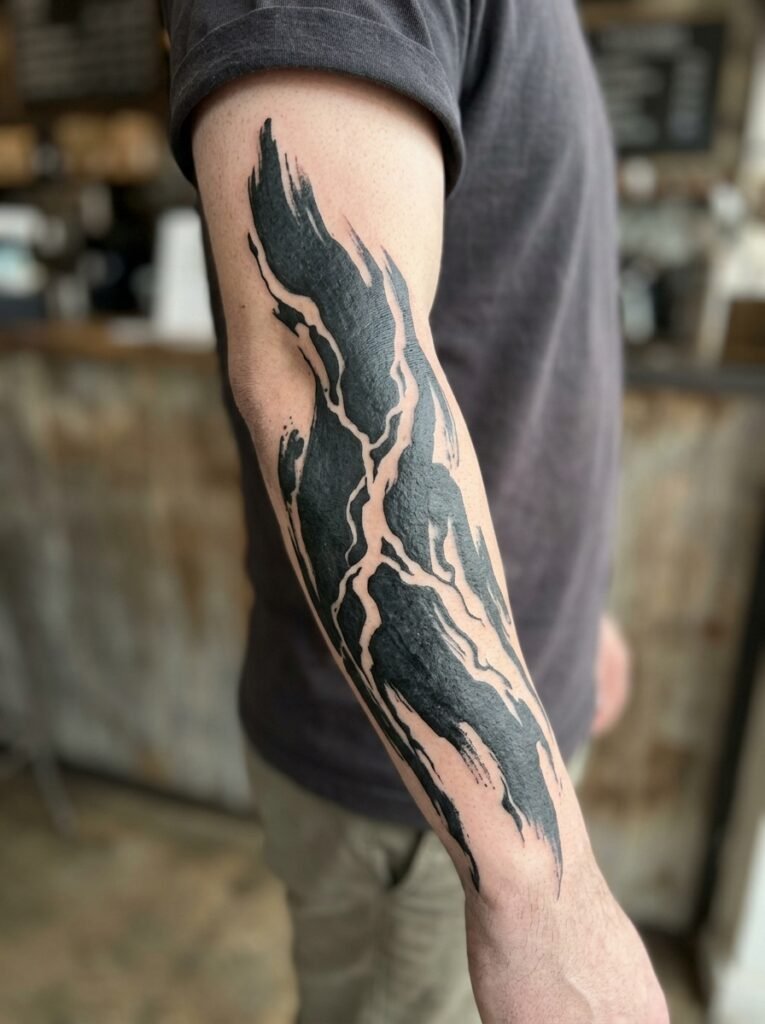
The outer forearm is the right canvas because the design benefits from a long directional movement. Pain is generally moderate, depending on how much solid black is packed into the piece. Choose this if you want something individual without committing to a recognizable image. It can be expanded later, but the original negative-space pattern should remain protected so the design doesn’t become visually crowded.
9. Realistic Lion With Smoke and Clouds
A realistic lion faces forward with detailed eyes, layered fur, and soft gray shading fading into atmospheric clouds around the lower mane. The eyes carry the strongest contrast while the surrounding smoke gradually disappears into bare skin, creating a dramatic photographic effect.
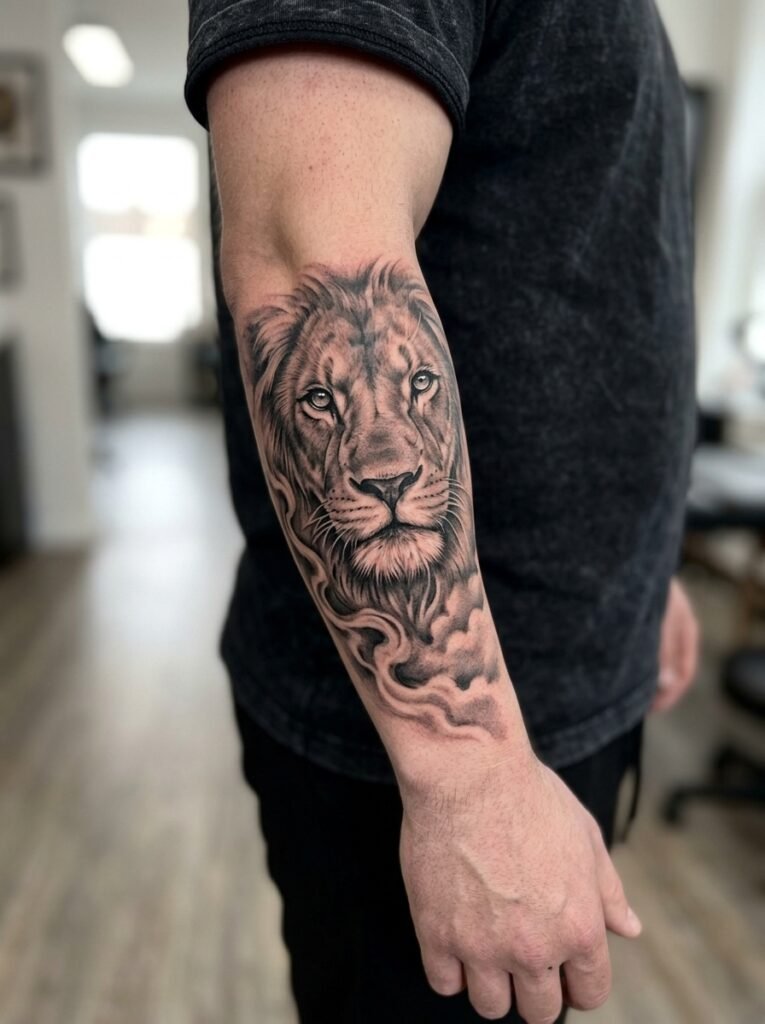
Keep the face on the wider upper outer forearm and allow the clouds to taper toward the wrist. Pain is moderate to high because realism requires extended shading sessions. This is better suited to someone comfortable with detailed work and artist maintenance. Choose an experienced realism specialist and keep facial features large enough to remain recognizable as the tattoo naturally softens over time.
10. Minimal Roman Numeral Date
A short Roman numeral sequence runs horizontally or slightly diagonally across the outer forearm in clean, evenly spaced lettering. There are no decorative distractions — only precise characters and subtle weight variation, producing a minimal design where spacing becomes the visual feature.
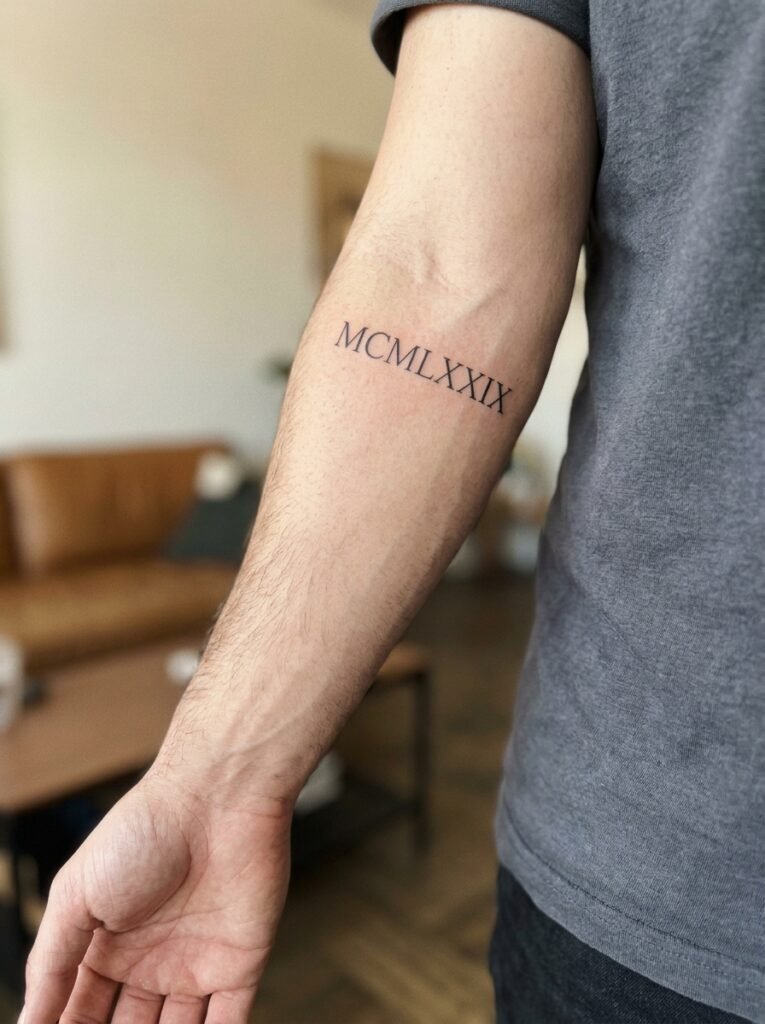
Place it away from the wrist crease and avoid pushing the lettering too small. Pain is generally low to moderate, making it approachable for a first tattoo. The date can be paired with a tiny symbol or fine border later. For aging, prioritize larger characters and generous spacing; microscopic lettering may blur faster than expected.
The right haircut can enhance the overall impact of your ink, while these Men Buzz Cut With Beard Ideas offer fresh ways to complete your personal style.
11. Black-and-Grey Portrait With Architectural Frame
A detailed male portrait sits inside a narrow architectural frame, with realistic facial shading contrasted against straight columns and small ornamental edges. The combination of organic skin texture and rigid architecture creates an illustrative tension that separates it from ordinary portrait tattoos.
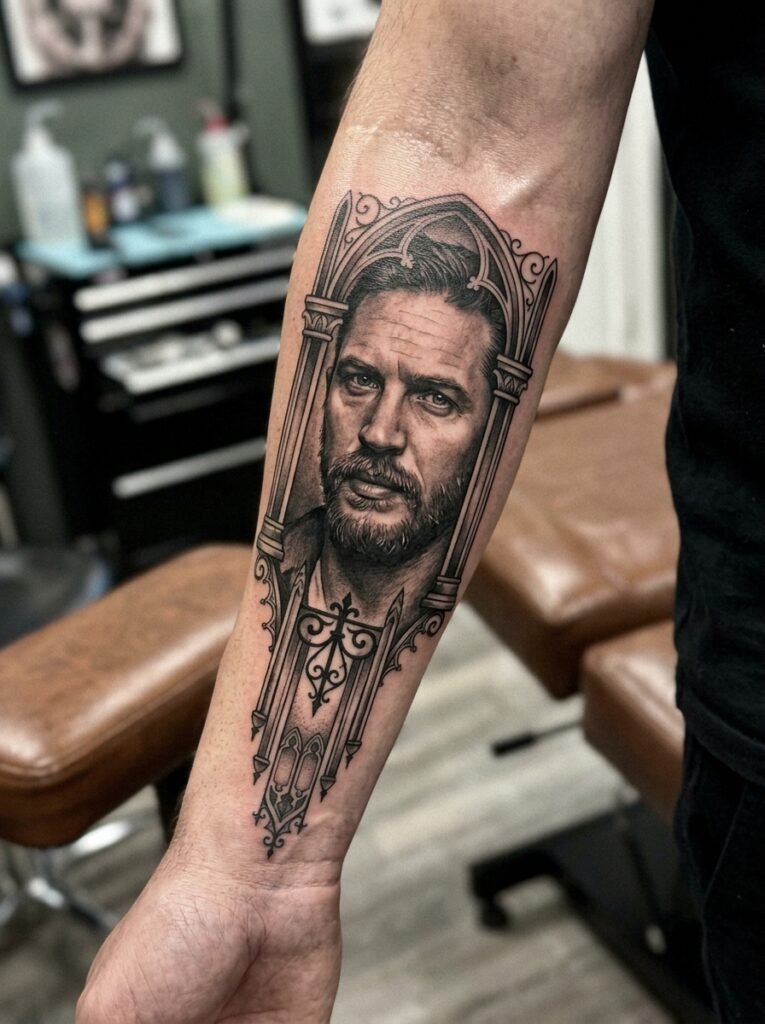
Use the upper outer forearm for the portrait and taper the architectural elements downward. Pain is moderate to high because facial realism demands concentrated shading. This works best for experienced collectors who have a specific subject in mind. A skilled portrait artist is essential; over the next decade, accurate proportions and strong contrast will matter more than tiny details.
12. Hand-to-Forearm Roman Warrior
A Roman warrior begins on the outer forearm with a helmeted profile, while a continuation of armor lines travels toward the hand. The composition uses bold outlines, engraved-style shading, and small ornamental details for a historical appearance that feels like an illustration from an ancient battle manuscript.
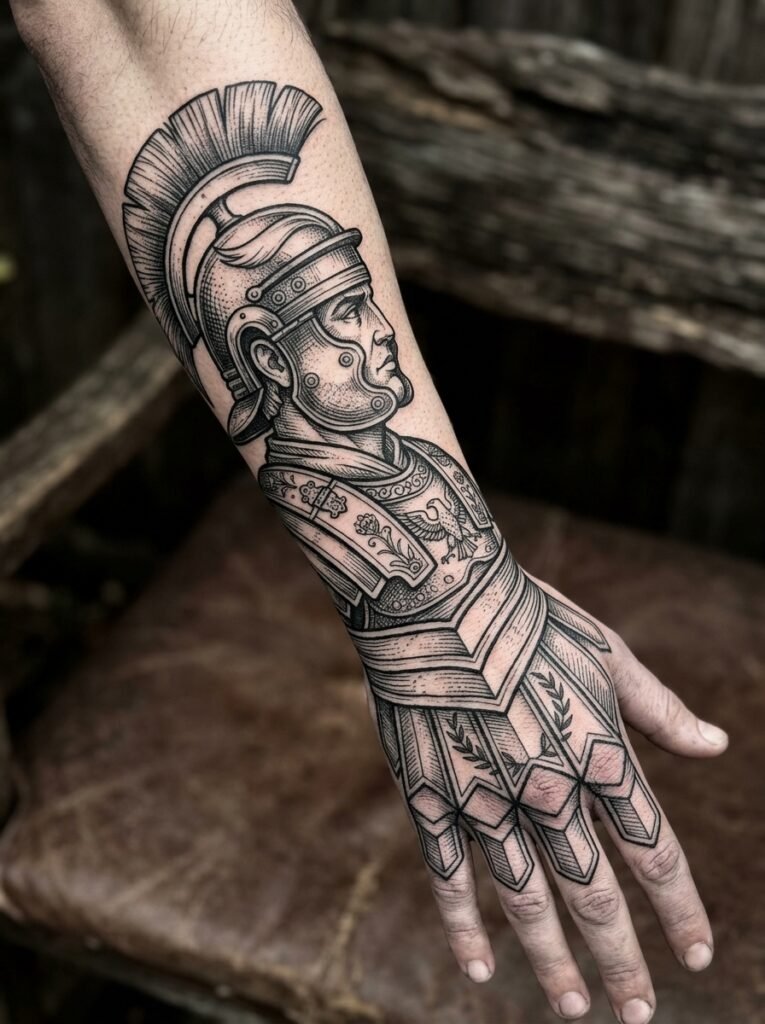
This is one of the more committed options because extending onto the hand increases visibility and career considerations. Pain can be higher on the hand than the forearm. It suits experienced collectors who already understand visible tattoo placement. Keep the forearm section visually complete on its own so the hand extension can be added later without making the original design feel unfinished.
13. Religious Cross With Clouds and Light Rays
A dark cross rises through layered clouds, with narrow beams of negative space cutting behind it to suggest light. The black-and-gray shading moves from dense cloud edges into softer gradients, creating a spiritual composition rather than a simple emblem.
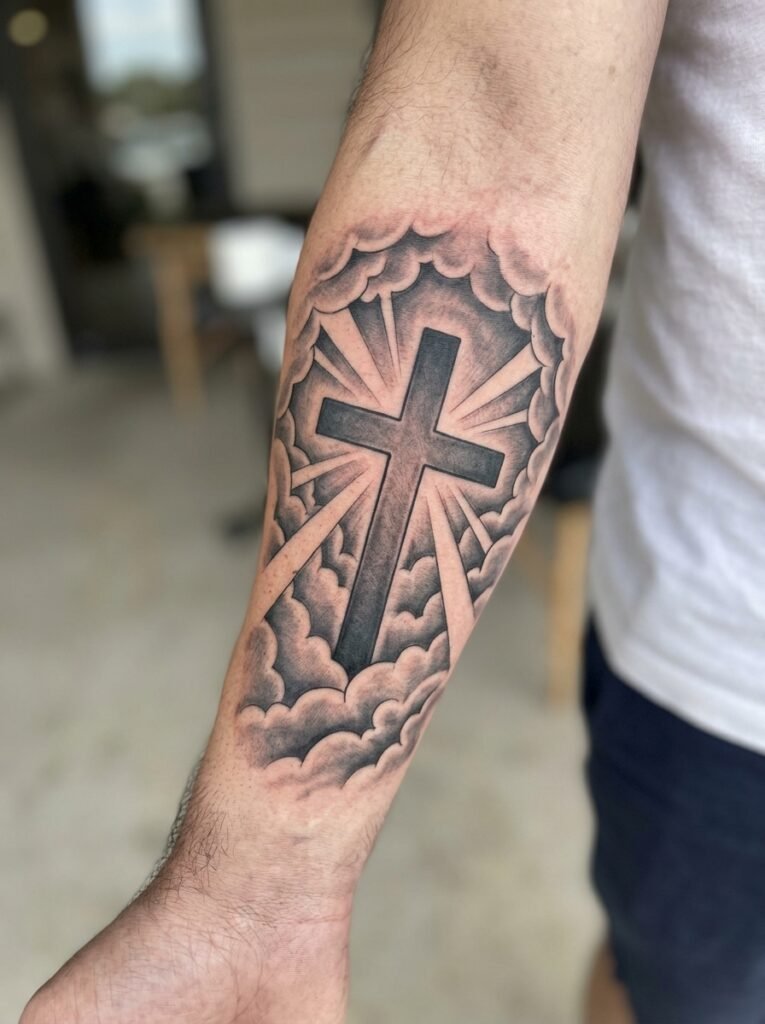
Center the cross vertically on the outer forearm and let the clouds widen toward the upper section. Pain is moderate, especially where heavier shading is required. It suits someone who wants religious symbolism with visual depth. You can add dates, scripture references, or subtle architectural details later, while strong contrast keeps the primary symbol readable for years.
14. Architectural Gothic Cathedral in Blackwork
A narrow Gothic cathedral rises vertically from the lower forearm, with pointed arches, spires, windows, and dense black shadows beneath the structure. Tiny architectural lines create an ornate miniature-building effect while the silhouette remains strong enough to read from a distance.
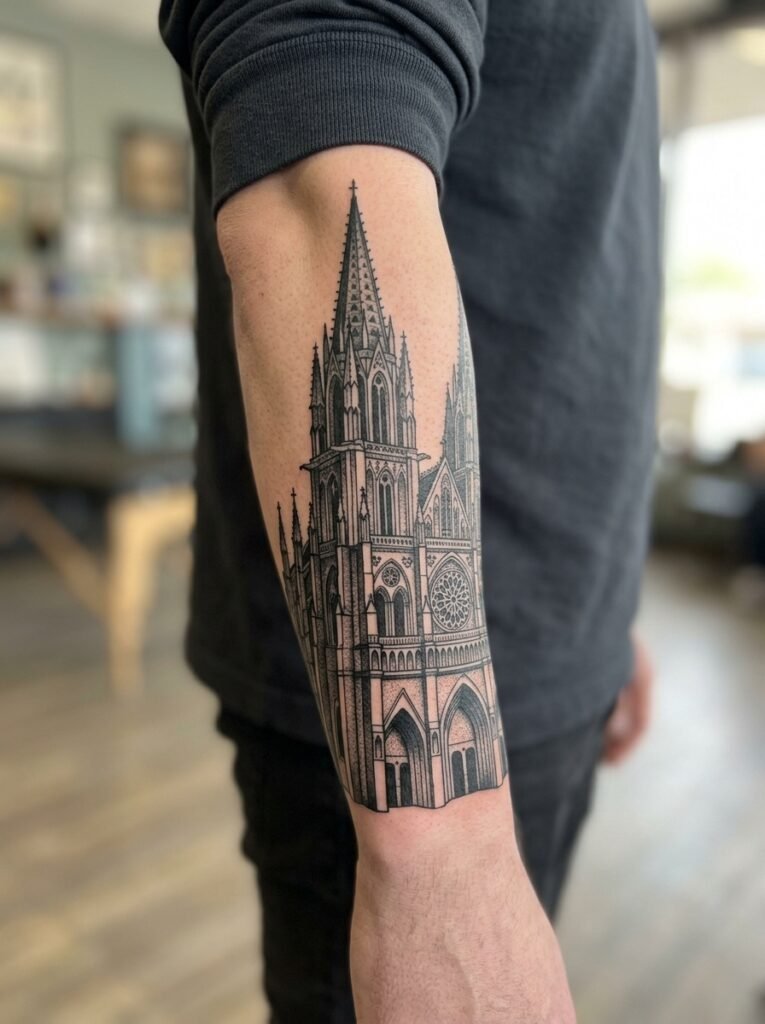
The outer forearm is almost tailor-made for this vertical composition, particularly when the structure follows the arm rather than sitting sideways. Pain is moderate and the design suits collectors who enjoy architecture, history, or darker aesthetics. Ask the artist to simplify micro-details where necessary; clear silhouettes and negative space will preserve the cathedral’s identity better than excessive detail.
15. Fine-Line Mountain Range With Moon
A thin mountain range stretches diagonally across the forearm, with a small crescent moon above and delicate pine silhouettes beneath. The mountains use almost no heavy shading, allowing the skin to remain visible and giving the composition a minimal outdoor-sketch aesthetic.
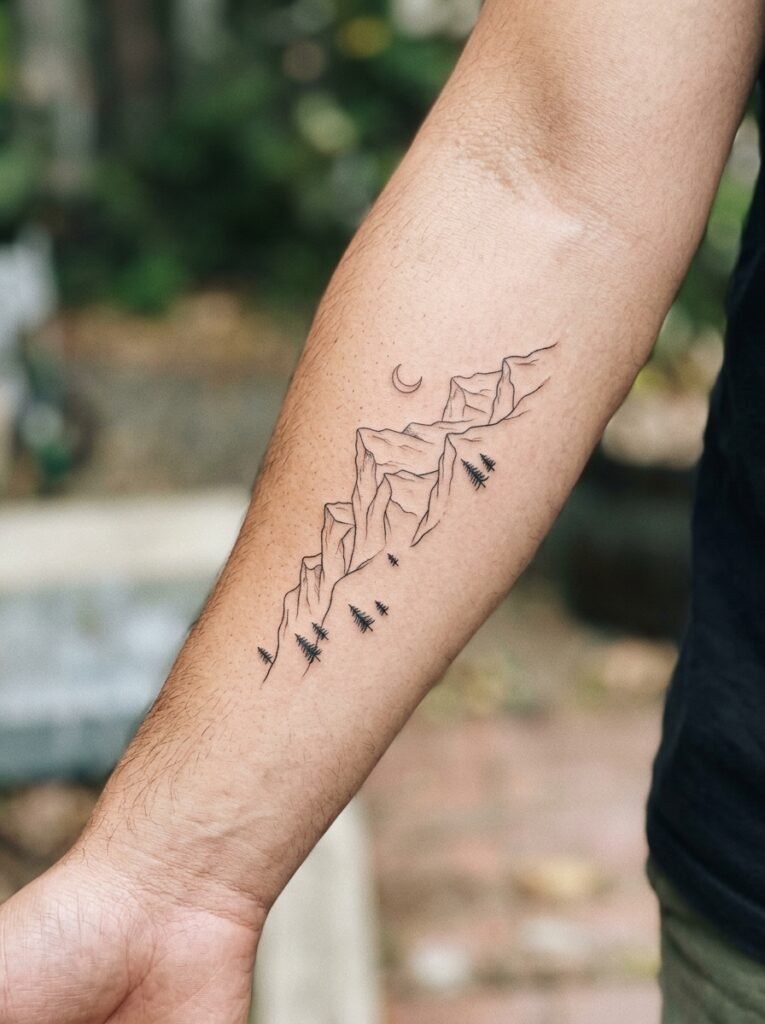
Place the mountains along the natural length of the outer forearm rather than wrapping them tightly around the arm. Pain is usually low to moderate. This is a strong first-tattoo option for someone who wants understated imagery. Keep the smallest trees separated and avoid excessive micro-detail; fine lines can soften, but thoughtful spacing helps the landscape remain recognizable.
16. Half-Sleeve Blackwork With Clouds and Animal Motifs
Dense black clouds form the foundation around a central animal head, while negative-space highlights create movement from the wrist toward the elbow. The result is a connected dark composition rather than several isolated tattoos placed beside one another.
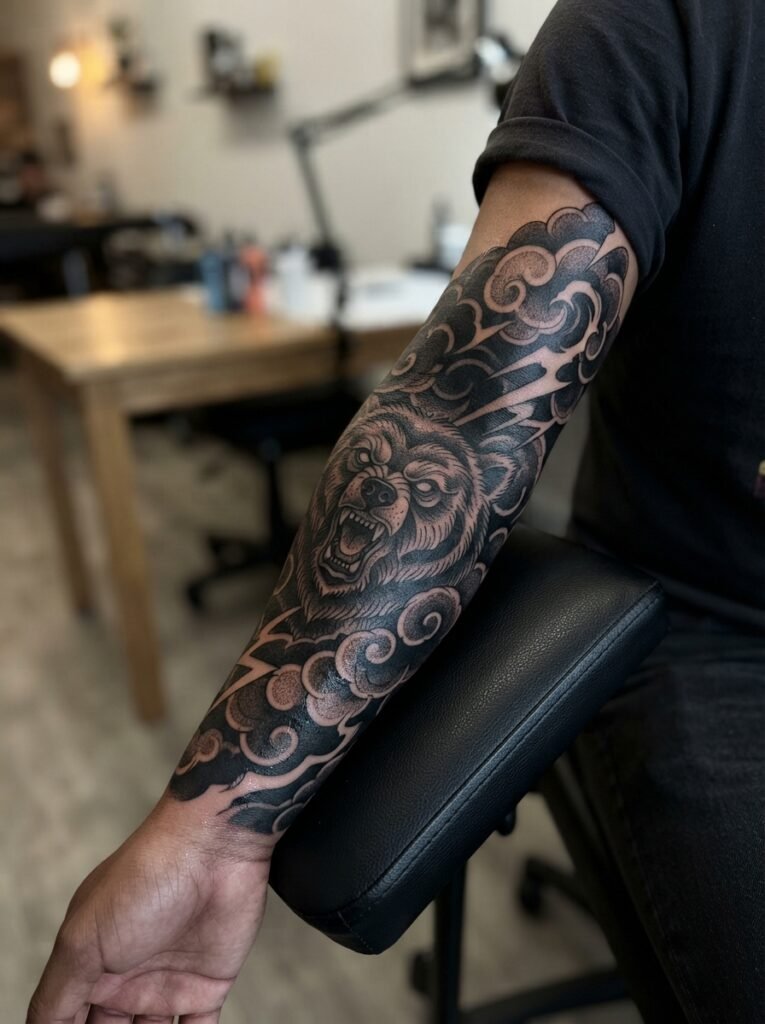
Start on the outer forearm with a strong focal subject and leave deliberate transition zones toward the elbow. Pain is moderate to high depending on the amount of saturation. This suits experienced collectors planning a larger sleeve. Work with an artist who designs the entire flow before tattooing; the best half sleeves look intentional from every angle and continue to age through strong shapes.
A strong tattoo often pairs naturally with facial hair, and these Men Beard With Bald Head Ideas can add another distinctive element to your appearance.
17. Unique Mythological Griffin in Engraving Style
A griffin combines an eagle’s head and wings with a lion’s body, rendered in dense engraving-style lines and controlled black shading. Feather textures, claw details, and curved wing shapes create a mythic image that feels lifted from an antique illustrated book rather than a modern fantasy poster.
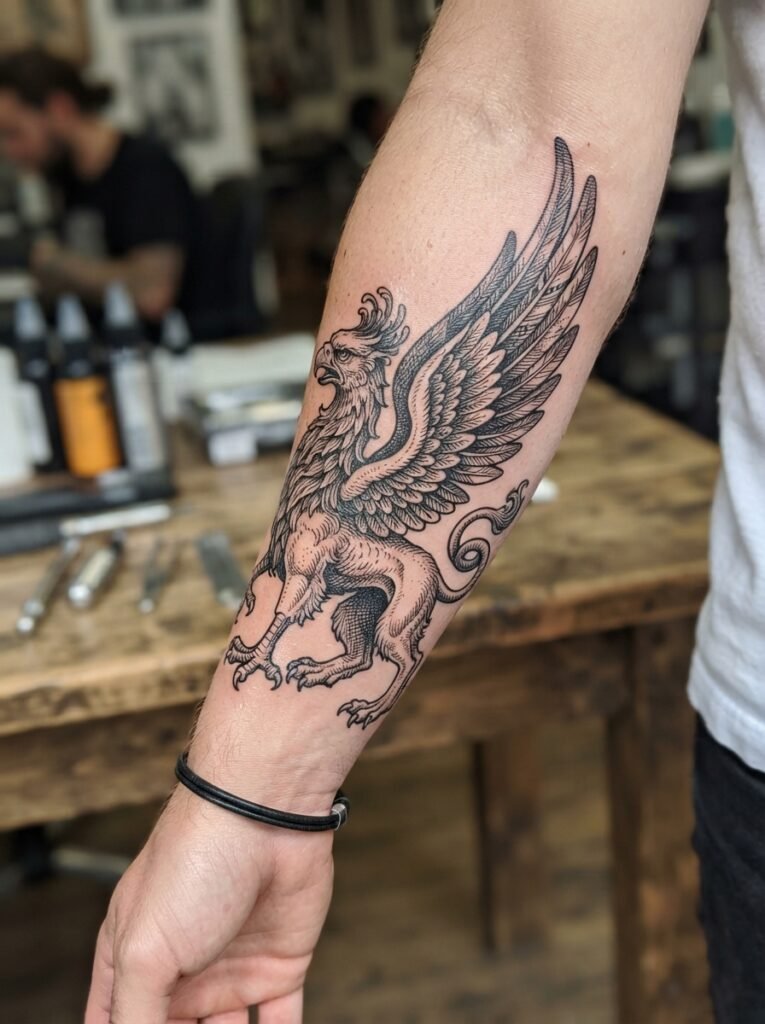
Place the body through the middle outer forearm with one wing following the arm’s vertical direction. Pain is moderate, with detail increasing the session time. This is ideal if you want a unique mythology-inspired piece without choosing an overused symbol. Keep the major silhouette bold and the engraving lines spaced enough to remain distinguishable as the tattoo ages.
How to Choose the Right Tattoo Style for Your Personality
Style choice isn’t just aesthetic — it’s a commitment question. The right style for you matches both your visual taste and your tolerance for detail, time in the chair, and long-term maintenance.
Minimalist / fine line: Choose this if your wardrobe and overall style lean clean, restrained, and understated. A single-needle compass with tiny olive branches gives you meaningful imagery without turning your forearm into a dominant visual feature.
Bold / blackwork / traditional: This suits you if you prefer contrast, recognizable silhouettes, and tattoos that remain visually strong from across a room. A blackwork lion with a heavy mane is a good example because its identity depends on shape rather than fragile detail.
Geometric / abstract: Choose geometry if precision, symmetry, and structure appeal to you more than conventional imagery. A fragmented geometric wolf can solve the problem of wanting an animal tattoo without ending up with another standard realistic wolf.
Illustrative / realistic: This direction fits someone who values storytelling and visual detail and is willing to spend more time with an experienced specialist. A black-and-gray portrait framed by architecture is the kind of design where artist skill matters more than simply having a good idea.
Symbolic / meaningful: Start with the meaning and build the visual language afterward. A cross surrounded by clouds, a Roman numeral date, or a mythological griffin can carry personal significance while still being designed specifically for your anatomy.
The worst reason to choose a style: it looks good on someone else’s forearm. The best reason: it matches how you approach every other aesthetic decision you make.
Best Tattoo Placements
| Placement | Visibility | Pain Level | Best Design Scale | Ages Well? |
|---|---|---|---|---|
| Forearm | High | Moderate | Medium–Large | ✓ Yes |
| Chest | Low–Medium | Moderate–High | Large | ✓ Yes |
| Back | Low | Moderate | Very Large | ✓ Yes |
| Wrist | High | High | Small | ⚠️ Fades faster |
| Upper arm | Medium | Low | Medium–Large | ✓ Yes |
What to Know Before Getting Your First Tattoo
Most tattoo regret is a research failure, not a design failure. Here’s what to know before you book.
Find the right artist: Don’t choose an artist because their studio is nearby. Look specifically at healed work and confirm they regularly tattoo the style you want; a brilliant realism artist isn’t automatically the right person for fine-line geometry.
Bring reference images: Three to five strong reference images communicate line weight, shading, composition, and style far better than saying, “I want a cool lion.” Your artist can then turn those references into an original design suited to your anatomy.
Get the size right: Tiny realism, crowded lettering, and miniature intricate scenes often shrink poorly. Give detailed designs enough physical space and let your artist explain what will still look clean years later.
Protect the first two weeks: Don’t pick or scratch the tattoo, don’t soak it in pools or baths, and don’t ignore your artist’s aftercare instructions. Those are three easy ways to interfere with healing and the final appearance.
Avoid false savings: Stay away from unnecessary sun exposure, pools, tight clothing rubbing the fresh tattoo, and shops chosen solely because they’re cheapest. A clean studio and experienced artist are worth paying for.
A tattoo is the one purchase you can’t return. Spend more time on the artist research than the design research — the right artist will improve your idea anyway.
If you already have one meaningful design, exploring more Naruto Tattoo for Men Ideas can help you discover complementary concepts for building a cohesive collection.
Frequently Asked Questions
How much does a forearm tattoo cost?
Pricing depends on artist experience, location, size, style, and session time. A detailed realism or blackwork piece will usually cost substantially more than a small minimalist design.
How long does a forearm tattoo take to heal?
The surface usually settles over roughly two weeks, but deeper healing continues beyond that. Follow your artist’s specific aftercare instructions rather than judging the tattoo only by how it looks after a few days.
What tattoo style ages the best?
Bold traditional and blackwork designs generally have strong long-term readability because they use clear outlines, solid shapes, and deliberate spacing. Fine-line work can also age well when it isn’t made excessively small or crowded.
Conclusion
The best men outer forearm tattoo ideas aren’t simply the most dramatic designs on a screen. You now understand how fine line, blackwork, geometric, realism, traditional, religious, and mythology-inspired concepts behave on the forearm — and why size, spacing, anatomy, visibility, and your future sleeve plans matter just as much as the artwork itself. Your strongest choice will align with your aesthetic identity, commitment level, and the artist’s actual specialty rather than whatever happens to be trending.
Before spending anything, save 5–10 reference images that share a consistent style — not 10 different styles you like equally. That collection is your brief. Take it to a consultation, not a booking, first. Let the artist challenge the size, placement, and details if necessary. A good tattoo is the one decision that gets better with time, not worse.